

Rubber is one of those materials that loves to humble a perfectly capable DIYer. I’ve watched clean repairs peel apart overnight, shoe soles flap loose after a single walk, gasket patches quit the second they had to flex. The right adhesive matters because rubber bends, stretches, and usually lives around water, heat, dirt, or all three at once.
And the best glues for rubber are not interchangeable. Some grab fast. Some stay bendy. Some are really built to stick rubber to metal, plastic, leather, or wood and fall apart anywhere else. I ran these through the kind of shop and household fixes most of us actually deal with, not lab-coat fantasy projects.
So the reviews below sort out which ones held, which made clean work easier, and which earn a permanent spot in the drawer for the next surprise repair. With rubber, the wrong glue is just temporary decoration.
Most rubber repairs are shoes, and if that is what you are holding, my glue for shoes picks are chosen for soles specifically.
Best Glues For Rubber in 2026
| Image | Model | |
|---|---|---|
 | Best Professional Choice Permatex Weatherstrip AdhesiveEditor's Choice  Check Price | Check Price |
 | Most Advanced Industrial Formula 3M PR100 Rubber GlueCheck Price | Check Price |
 | Best for Shoes & Flexible Gear Shoe Goo ClearCheck Price | Check Price |
 | Best Heavy-Duty Super Glue Gorilla Gel XLCheck Price | Check Price |
 | Best for Easy, Precise Application Loctite Ultra GelCheck Price | Check Price |
 | Most Versatile E6000 Clear CraftCheck Price | Check Price |
 | Best for Water & Outdoor Gear Aquaseal FD GlueCheck Price | Check Price |
Worth sorting one thing before the reviews, because it changes the answer completely: rubber bonded to something else fails at whichever side is fussier, not at the rubber. For a synthetic sole or a flexible plastic part, that is the plastic — my glue for plastic guide covers those.
1. Permatex Black Super Weatherstrip Adhesive

This Permatex is the one I treat as shop-grade, not a junk-drawer fix. It’s a professional black weatherstrip cement built for vehicles, trailers, RVs, and any spot where rubber trim has started flapping around like it owns the place. The work it’s made for is rubber-to-metal, rubber-to-trim, and rubber-to-interior material, the kind of seal job you want done right the first time rather than a delicate craft bond.
It’s a contact-type cement, so I run it like one. Scuff off the powdery mold-release film first, lay a thin, even film on both surfaces, let them tack up for a few minutes, then press firm. This stuff gets grabby. That’s a gift once the rubber is sitting exactly where you want it, and a wrestling match if a long floppy seal kisses the wrong spot first. I work in short sections instead of coating a whole long strip at once, and it behaves.
What earns it the pro slot is how it holds up. It’s built for the abuse a working vehicle dishes out: temperature extremes and splashes of gasoline, antifreeze, kerosene, and most common solvents. The black color hides on dark seals, so the repair stays tidy, though I wouldn’t pick it for a visible light-colored job. Door seals, trunk moldings, cut gaskets, carpeting, vinyl-backed material, headliner work, it handles all of it. This isn’t a grab-and-go gel for a five-minute fix. It’s what I reach for when the seal has to last.
Pros:
- Professional-grade weatherstrip cement made for gaskets, seals, and automotive trim
- Black finish blends into dark vehicle seals and keeps the repair tidy
- Resists temperature extremes plus gasoline, antifreeze, kerosene, and most solvents
- Useful on several shop and vehicle materials, not just rubber
Cons:
- Gets tacky fast, so long strips need patient, section-by-section work
- Black adhesive is not ideal where a clear or invisible bond is needed
Pros:
- Strong choice for rubber weatherstripping, gaskets, and automotive trim repairs
- Black finish suits most dark vehicle seals and keeps the repair looking tidy
- Made to handle temperature changes and exposure to common automotive chemicals
- Useful on several shop and vehicle materials, not just rubber
Cons:
- Can become tacky fast, so long strips need patient, section-by-section work
- Black adhesive is not ideal where a clear or invisible bond is needed
2. 3M Scotch-Weld PR100 Fast Rubber Adhesive

3M Scotch-Weld PR100 is not the bargain-bin tube I toss in a junk drawer and forget about. This is a thin, fast cyanoacrylate made for rubber and plastics that usually make ordinary super glue throw in the towel. In the rubber-glue category, I like it most for small, clean contact areas: gaskets, trim pieces, small assemblies, repairs where the parts fit tight and I want a quick grab.
The big advantage here is speed. It reaches a workable hold almost immediately, while the final cure takes 24 hours. The bottle is small at 20 g, but the flexible container gives good control whether I need a single dot or a slightly longer line. Since it’s low-viscosity, I treat it like a precision adhesive rather than a filler. If the joint has gaps, missing material, or a rough break, this wouldn’t be my first pick.
Worth noting: this one is listed for industrial or occupational use, not regular consumer use. I’d use gloves, keep it off skin, and test first on unknown plastics. With the right primer it can grab some extra-stubborn materials, but I wouldn’t skip surface prep and expect miracles. Rubber may be forgiving in a tire-shop joke. Glue sure isn’t.
Pros:
- Excellent fit for small rubber and plastic bonding jobs
- Sets up quickly enough to keep a repair moving
- Thin formula works well where a tight bond line is needed
- Flexible bottle helps with controlled application
Cons:
- Not a gap-filling adhesive
- The 20 g bottle empties fast, so it’s not built for big jobs
3. SOF SOLE Shoe Goo Clear Repair Glue
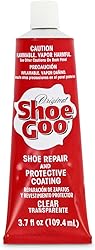
For rubber shoe repairs, SOF SOLE Shoe Goo is the kind of product I keep mentally filed under “small tube, big save.” It’s made for footwear problems like loose soles, worn heels, and little holes, and that puts it right in the sweet spot for rubber repairs that need some flex instead of a brittle snap.
I like that it works beyond plain rubber, too. Leather, vinyl, and canvas all make the compatible list, so it covers sneakers, work shoes, sandals, rubber boots, and similar gear. The clear finish helps keep repairs from screaming for attention, though I still take my time with masking and cleanup because this stuff gets messy if you overdo it.
The big thing is patience. It wants to be left alone for about 24 hours on most materials, and clamping or weighting the repair is the smart move. The bond holds up in wet conditions once cured, which is a major plus on shoes. The tradeoff is the strong solvent smell. I use it with good airflow and gloves, because nobody needs glue fingerprints as a fashion statement.
Pros:
- Excellent fit for rubber soles, heels, small holes, and shoe patching
- Clear formula keeps many repairs fairly low-profile
- Works on several common footwear materials, including rubber, leather, vinyl, and canvas
- Waterproof once cured, making it useful for boots, galoshes, and outdoor shoes
Cons:
- Strong odor means ventilation is not optional
- Can be messy, and excess glue should be handled before it cures
4. Gorilla Super Glue Gel XL For Rubber

I like this Gorilla gel for rubber jobs where a thin super glue would run off and make a mess before I could line the parts up. The thicker body gives me better control on small repairs, vertical spots, and awkward little edges. In a shop drawer full of half-used adhesives, that matters. Nobody needs a glue bottle that behaves like a spilled soda.
For rubber, plastic, metal, wood, ceramic, leather, glass, and similar household materials, this is the quick-grab adhesive I reach for when the repair is small and needs to stay put fast. The 25g bottle is more practical than tiny one-and-done tubes, and the pointed applicator helps me place a small amount without flooding the joint. I still give it the full cure time before I trust the repair under real use, but the initial hold is quick enough that I’m not standing there forever pinching parts together.
The finish is meant to be clear, though I’d be careful on porous craft materials where it can show lighter than expected. And like any super glue, it rewards patience and a light hand. Too much adhesive can slow things down or weaken the result. Used sparingly on clean, dry surfaces, it’s a strong, convenient pick for small rubber fixes and mixed-material repairs around the house.
Pros:
- Gel consistency gives better placement control than runny liquid glue.
- Works on rubber along with many common repair materials.
- Fast initial set makes small fixes easier to handle.
- 25g size is useful if I do frequent household repairs.
Cons:
- Can appear whitish on some porous materials.
- The nozzle can become troublesome if the cap is not handled carefully after use.
5. Loctite Ultra Gel Control Super Glue

Same gel logic as the Gorilla above, just in a smaller, finer package. I reach for this Loctite when I need a controlled rubber repair and don’t want thin glue racing across the workbench like it has somewhere better to be. The gel body makes it easy to drop a tiny bead on edges, tabs, trim pieces, and odd little household fixes where regular super glue turns into a mess fast.
The side-squeeze bottle is the big practical win for me. It gives better control than a basic metal tube, especially when I’m lining up small parts or working on a vertical surface. It grabs quickly, but the formula isn’t so frantic that I feel like I get one clumsy shot and the project is ruined.
For rubber, this is best on small repairs where a fast cyanoacrylate bond makes sense. I also appreciate that it cures clear and shrugs off everyday knocks better than brittle bargain-bin super glue. The catch is the tiny 0.14 fl oz bottle, and it’s not the right pick for silicone, foam rubber, PE, PP, PTFE, very soft leather, glass, dishwasher items, oven use, or microwave use.
Pros:
- Gel consistency stays put better than thin super glue.
- Side-squeeze bottle helps with neat, precise application.
- Works on rubber along with several common repair materials.
- Clear finish is helpful on visible fixes and small crafts.
Cons:
- Small bottle can run out quickly if used for larger jobs.
- Not suitable for silicone, foam rubber, and several low-surface-energy plastics.
6. E6000 230010 Clear Craft Adhesive

E6000 230010 is my pick when a rubber job wanders off into craft, repair, and light-workshop territory. It isn’t a rubber-only glue, and that’s the point. Rubber meets wood, metal, ceramic, leather, fabric, or vinyl, and that’s exactly where a lot of real repairs get annoying. This one shrugs at the mix.
The clear finish is a big plus when I’m fixing something visible, because I don’t want a sloppy glue line stealing the show. It can also be painted, which gives me a little room to clean up the look after the bond is done. For small shoe fixes, garden decorations, craft assemblies, and oddball household repairs, this is what I reach for when I want strength without turning the project into a chemistry exam.
I wouldn’t call it my fastest grab-and-go adhesive. If I need an instant tack like the Gorilla or Loctite gels above, this is not the same animal. But for a durable bond across awkward materials, rubber included, it earns its spot on the bench. Just give it the time it needs, and don’t rush the cure like a guy trying to paint over wet caulk. Ask me how I know.
Pros:
- Works with rubber along with wood, metal, ceramic, vinyl, leather, fabric, and more.
- Clear cured look helps keep visible repairs neat.
- Paintable after drying, which is handy for finished craft and repair work.
- Temperature resistant and non-flammable once fully cured.
Cons:
- Not the best pick when I need super-fast bonding.
- Plastic-to-plastic repairs are worth testing before trusting on an important job.
7. GEAR AID Aquaseal FD Flexible Repair Glue

If a repair needs to bend, get soaked, and keep going, this is the one I pull out. Rubber boots, waders, wetsuits, PVC inflatables, vinyl gear, that’s the world it’s built for. Where the Shoe Goo up top handles everyday footwear, the Aquaseal is the heavier-duty waterproofer. It cures into a rubber-like urethane patch instead of a stiff little scab, and that flexibility is the whole ballgame on outdoor gear.
The 0.75 oz tube is sized for repairs, not for coating half the garage, but it handles common tears, seam touch-ups, pinhole leaks, and worn spots if I don’t get sloppy with it. It works on rubber, neoprene, nylon, canvas, leather, GORE-TEX fabric, PVC, and vinyl, which makes it far more useful than a one-trick shoe glue. It sets up clear, too, though I’d still expect it to show a bit on lighter colors or if I lay it on too heavy. Glue has a way of telling on you.
The tradeoff is patience and neatness. This is not the glue I’d grab five minutes before heading out the door, since the cure time runs 8 to 12 hours. It can get messy on seams or vertical spots, so I’d rather apply it carefully in controlled layers than gob it on and hope for mercy. Done with a little prep and restraint, it’s a strong pick for waterproof rubber repairs that still need to move.
Pros:
- Stays flexible after curing, which is ideal for boots, waders, wetsuits, and other gear that bends.
- Works across several outdoor materials, including rubber, neoprene, PVC, vinyl, nylon, canvas, leather, and GORE-TEX fabric.
- Designed for water-sealing repairs, making it useful for leaks, tears, and seam reinforcement.
- Clear finish helps keep repairs less noticeable, especially on darker gear.
Cons:
- Needs 8 to 12 hours to cure, so it is not a quick emergency fix.
- Application can get messy without a careful hand or a small brush.
What Actually Sticks to Rubber (and What Doesn’t)
Here’s what nobody tells you upfront: rubber is a pain to glue. It flexes, it stretches, and a lot of it ships with oils or mold-release agents baked into the surface at the factory. That’s why your trusty bottle of wood glue laughs in your face when you try it on a boot sole. You need an adhesive that can move with the rubber and grip a surface that’s basically designed to shrug stuff off.
The big players for rubber bonding fall into a few camps, and each one has a job it’s genuinely good at:
- Cyanoacrylate (super glue) — fast, strong, great for small repairs but brittle once cured, so it hates flexing. The Gorilla and Loctite gels I reviewed up top both live here.
- Contact cement — the king for big flat surfaces like shoe soles and rubber sheeting. You coat both sides, let it tack up, then press together.
- Polyurethane adhesives — flexible, waterproof, and forgiving on rough or uneven joints. That’s the Aquaseal from the reviews.
- Rubber cement — low strength, repositionable, mostly for light-duty or temporary stuff. Don’t use it on your hiking boots and expect miracles.
If you want to geek out, the folks at ASTM (standard D429) literally wrote the testing methods for how well adhesives bond rubber to rigid surfaces. It’s the same benchmark serious manufacturers lean on.
Match the Glue to the Rubber Type
Not all rubber is created equal, and that trips people up. EPDM, the stuff in roofing and weather seals, is notoriously slippery and wants a specialty primer or an EPDM-specific adhesive. Regular super glue won’t touch it. Natural rubber and neoprene play nicer with contact cement. Silicone rubber is its own beast. Only silicone-based adhesives bond to it reliably, and trying anything else is just a wasted afternoon.
If you don’t know what kind of rubber you’ve got, test your glue on a hidden spot before committing to the whole repair. Been there, glued the wrong thing, peeled it right back off an hour later. A little test patch saves a lot of swearing. The same caution applies when the other half of the joint is hide — leather glue is formulated to stay flexible without staining it.
Flexibility vs. Strength: Pick Your Priority
This is the trade-off that matters most. A bond that’s rock-hard and super strong is useless if the rubber needs to bend, because the glue line cracks the first time it flexes. Flip it around, and a flexible adhesive might not hold up under heavy pull-apart stress.
So ask yourself: is this part going to move? A rubber gasket on a fixed fitting takes a rigid cyanoacrylate just fine, one of those gels from the reviews would do it. A shoe sole, a tire patch, a rubber strap? Those need flex, which means contact cement or a polyurethane like the Aquaseal every time. For anything that bends in normal use, skip the brittle super glues and go flexible, or you’ll be re-gluing it next weekend.
Surface Prep Makes or Breaks It
I can’t say this enough. Prep is where most rubber glue jobs go to die. Rubber surfaces are often coated with oils, dust, or that waxy mold-release film, and glue won’t stick to any of it. Here’s the routine that actually works:
- Clean the surface with isopropyl alcohol or acetone to strip oils. Test the acetone on a hidden spot first, since it can melt some rubbers.
- Lightly rough up the surface with fine sandpaper to give the glue something to grab.
- Wipe away the dust and let it dry completely before applying adhesive.
In my experience, that quick scuff with sandpaper does more for the bond than any upgrade in glue. Skip the prep and even a great adhesive pops off in the parking lot. That five minutes is the difference between a repair that lasts years and one that quits on you the same day. Rubber-to-metal is the one case where prep alone will not save you: the metal side wants its own primer step, which I went through in my glue for metal roundup.
Cure Time and Working Time
Super glues grab in seconds, which is great right up until you realize you positioned the part wrong and now your fingers are part of the project. Contact cement gives you a short tack-up window to line things up, but once those surfaces meet, that’s it. No second chances. Polyurethanes are the relaxed ones, with real working time, though they take hours to cure all the way.
Whatever you pick, give the bond its full cure before you stress it. The label might brag “handles in 5 minutes,” but full strength often takes a day. Rushing the cure is the number one reason a perfectly good glue job fails. Walk away and let it sit overnight.
Don’t Ignore Safety
A lot of these adhesives, especially solvent-based contact cements and cyanoacrylates, kick off fumes that’ll knock you sideways in a closed garage. Cyanoacrylate vapor stings your eyes and lungs, and contact cement is flammable enough that you want zero open flames anywhere near it. Crack a window, run a fan, and wear nitrile gloves unless you enjoy peeling glue off your skin for a week.
OSHA’s chemical hazard guidance covers proper handling for industrial adhesives if you’re working in volume or in a shop setting. And if you’d rather keep things on the greener side, the EPA’s Safer Choice list flags adhesive ingredients that are easier on you and the environment. Always work in a ventilated space with solvent-based rubber adhesives. Those fumes are no joke in a sealed room.
Waterproof and Outdoor Considerations
If your rubber repair is going to live outdoors or get wet, think pond liners, boots, gaskets, automotive trim, you need an adhesive rated for it. Polyurethane and certain contact cements shrug off water and temperature swings. Standard rubber cement and basic super glue will let you down fast once moisture creeps into the joint.
Temperature matters too. Some adhesives turn brittle in the cold or go soft in the heat, so check the working-temperature range if your project sees extremes. For automotive and outdoor gear I keep coming back to a polyurethane like the Aquaseal or a marine-grade contact cement. They’ve never let me down, and that’s saying something from a guy who’s glued just about everything at least once.