

A router table can turn a hand held router into a small shop powerhouse, but it can also turn a calm afternoon into a lot of fussy knob turning if you pick the wrong one. I have spent plenty of time setting up, flattening, squaring, and test cutting on different tables, and the best router table is the one that stays accurate when you lean into a long edge, holds adjustments without drifting, and makes bit changes feel like a normal part of the job instead of a mini project.
In the roundup ahead, I will walk through five tables that earned a spot on my bench and explain what each one does well and where it asks you to compromise. If you are chasing cleaner profiles, tighter joinery, or just a setup that does not fight you, keep reading. There are a couple of small design details that separate a joy to use from a tool you only tolerate, and they are not always the ones that look flashy on the box.
Best Router Tables in 2026
| Image | Model | |
|---|---|---|
 | Best Overall Bosch RA1181Editor's Choice  Check Price | Check Price |
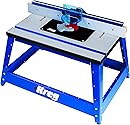 | Best Value Kreg PRS2100 TableCheck Price | Check Price |
 | Best for Precision SKIL RT1323 ComboCheck Price | Check Price |
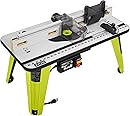 | Best Budget Ryobi A25RT03 TableCheck Price | Check Price |
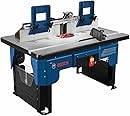 | Best Portable Bosch RA1141 TableCheck Price | Check Price |
1. Bosch RA1181 Portable Aluminum Router Table

If you want a router table that behaves like a serious shop tool but still earns its keep in a tight space, this Bosch benchtop setup hits a sweet spot. The aluminum top feels like it’s built for real work – solid, stable, and the kind of surface that doesn’t make me babysit every pass for fear of sagging. For a “pick it up and move it” table, it has a surprisingly planted feel.
The fence is one of the big reasons I’d put this on a “best router table” list. It’s tall, it’s stiff, and it’s set up for actual control: adjustable faces and featherboards that let me guide stock cleanly without getting creative with clamps and prayers. I also like that it’s ready for edge-jointing with included outfeed shims. It’s not an endless micro-adjust system, but it’s quick to set up and gets me where I need to go for typical jointing tasks.
Dust control is another area where this table acts like it respects your lungs. The built-in port takes a standard 2-1/2 in. hose, and with a vac attached it does a good job keeping the mess from turning into a full-blown shop snowstorm. Add in the accessory slot for featherboards and 3/4 in. add-ons, plus a storage pocket for bits and small router odds and ends, and it’s clear this was designed by someone who’s actually spent time at a bench.
Pros:
- Large aluminum work surface feels sturdy and precise for benchtop routing
- Tall, rigid fence with adjustable faces and featherboards helps keep cuts controlled
- Standard-size dust port makes it easy to hook up a vacuum for cleaner routing
- Pre-drilled mounting plate supports multiple routers and above-table height adjustment with many common models
Cons:
- Assembly can be time-consuming due to the number of parts
- You’ll want to double-check router compatibility with the pre-drilled mounting plate before committing
2. Kreg PRS2100 Portable Benchtop Router Table
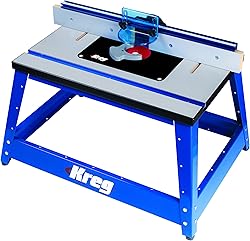
When I want a full-size working surface without committing permanent floor space, this Kreg benchtop table hits a sweet spot. The top is MDF with edging and a slick skin, and in day-to-day use it helps stock glide without feeling like I’m wrestling it. It’s also a calmer-running setup than a lot of lightweight tables – less buzz in the hands and less racket on the bench.
The fence is the heart of any router table, and this one gives me the kind of control I expect in a serious shop accessory. I like having split faces and positive locks, and I especially appreciate the built-in jointing ability. For edge work and straightening small pieces, that jointing function can cover a lot of ground that would otherwise push me toward a dedicated machine.
My main caution is that getting everything dialed in can take patience. The insert plate leveling system is a real asset once tuned, but setup and router mounting can be fussy depending on the router and how precise you want the centering. Also, dust collection is centered at the fence port, so if I’m not paying attention, a fair amount can still end up underneath the table.
Pros:
- Full-size benchtop surface that stays portable for small shops
- Smooth, low-friction top helps workpieces slide predictably
- Fence design supports accurate setups and includes jointing capability
- Insert plate leveling system helps fine-tune for better accuracy
Cons:
- Setup and tuning can take time, especially around router mounting and squaring
- Dust collection focuses at the fence, so under-table dust can still be an issue
3. SKIL RT1323 Router Table And Router Combo

I like tool combos when they feel like they were meant to live together, and this SKIL kit fits that bill. The table gives me the essentials I actually reach for while routing – a fence that spans a good width, featherboards for control, and a starter pin for safer, smoother lead-ins on freehand-style work. The side storage is simple, but it keeps the small stuff from wandering off my bench, which is half the battle in a busy shop.
The standout in day-to-day use is the above-table bit height adjustment. I can sneak up on a fit without crawling under the table, and that saves time and patience. The included fixed-base router has the power and control I want for common table jobs like grooves and edge profiles, and the variable-speed control helps match the cut to the bit and material. Soft start is a nice touch too – it makes the whole setup feel less jumpy when I hit the switch.
That said, the table acts like what it is – a smartly priced setup, not a cast-iron cabinet machine. The fence can take some care to get dialed in, and I treat it with respect when I need repeatable, super-fussy alignment. Dust collection is doable if I hook up a vacuum, and I consider that more of a requirement than a nice-to-have if I want a clear view of the cut line.
Pros:
- Above-table height adjustment makes fine tuning fast and painless
- Variable speed and soft start help keep cuts controlled and predictable
- Comes ready to work with featherboards, starter pin, and integrated bit storage
- Good overall capability for common routing tasks without spending big
Cons:
- Fence can be finicky to keep perfectly locked and aligned for ultra-precise work
- Dust management works best with a vacuum hooked up – otherwise the work area can get messy
4. Ryobi A25RT03 Universal Router Table
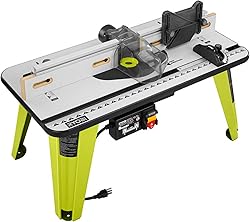
I like a router table that doesn’t feel like a compromise, and this Ryobi A25RT03 has the kind of solid, planted build that makes me comfortable running real projects across it. It goes together without drama, and once it’s set up, it feels more like a shop tool than a flimsy accessory.
What I keep coming back to is how much is built into the package. The fence adjusts easily, and having things like a guard, featherboard, and miter gauge on hand makes it simpler to get consistent results without improvising half the setup. The layout markings are also trustworthy enough that I’m not constantly second-guessing where I’m at.
Compatibility is the one place I don’t mess around. It’s a great match for the right router – especially if you’ve already got a Ryobi that fits – but it’s not a universal miracle. I’ve run into cases where a different-brand router won’t bolt up without significant modification, so I’d verify fit before counting on it. Also, there are a couple small annoyances: the fence faces can be a little imperfect in alignment, and the power cord length can feel stingy.
Pros:
- Sturdy, confidence-inspiring table once assembled
- Includes a lot of useful setup hardware for common routing tasks
- Adjustable fence and clear measurement markings help with repeatable work
Cons:
- Router compatibility can be picky – double-check before buying
- Minor fit-and-finish gripes like fence alignment and a short cord
5. Bosch RA1141 Portable Benchtop Router Table
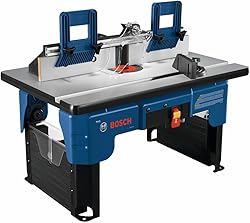
When I need a router table that can live in a tight shop – and still get out of the way when I’m done – this Bosch benchtop setup makes a lot of sense. The folding legs are the whole story here: quick to pop open, quick to stash, and I’m not sacrificing bench space for a tool that’s only needed at certain steps of a build.
The table surface is laminated MDF, and in day-to-day work that’s a practical choice. Stock slides smoothly, which helps me stay consistent on edge profiles and other routine routing tasks. I also appreciate that it shows up ready to go – no assembly games before I can make the first cut.
The fence is tall and comes with two adjustable featherboards, which gives me better control when I’m feeding material past the bit. For curved work, the starter pin and guard make the process feel more manageable. Little touches like onboard storage for bits and spare parts, plus a bit-height gauge for setup, keep me moving instead of digging around the shop for the next thing I need.
Pros:
- Folding-leg design is genuinely convenient for fast setup and storage
- Smooth laminated MDF top helps material track cleanly for precise cuts
- Tall fence with adjustable featherboards adds control during feeds
- Nice practical extras – onboard storage, starter pin and guard, and a bit-height gauge
Cons:
- Benchtop format means I still need a solid spot on the bench to run longer or awkward stock
What Makes a Router Table Worth Your Money
Trust me, after years of working on everything from small detail pieces to full kitchen cabinet sets, the fence system is what separates the pros from the pretenders. You want a fence that stays square, adjusts smoothly, and doesn’t drift during operation. I’ve fought with cheap fences that moved mid-cut — talk about a way to ruin a perfectly good piece of wood and your entire afternoon. Look for split fence faces with positive locks — that’s what lets you set the outfeed side independently for jointing, like the Kreg PRS2100 does. A fence that only adjusts as one piece limits what you can do down the road.
Table flatness isn’t negotiable either. I learned this the hard way when I bought my first router table thinking “close enough” would work. It doesn’t. Even a few thousandths of an inch can throw off your cuts, especially when you’re doing precision work like flush-trimming template pieces or routing dados for shelf pins.
Size and Power Considerations
Here’s something nobody tells you upfront: bigger isn’t always better, but too small will drive you crazy. I started with a compact benchtop model thinking I’d save space in my already cramped shop. Big mistake. You need room to maneuver larger pieces, and trust me, you’ll eventually want to run something bigger than a jewelry box through there. If space is genuinely tight, look for folding legs like the Bosch RA1141 — it stashes flat but still gives you a usable surface when it’s open.
Router compatibility is another headache waiting to happen. Some tables only work with specific router models, while others have universal plates. Go universal if you can — I’ve switched routers three times over the years, and having a flexible table saved me from buying a whole new setup each time. Also pay attention to how you adjust bit height. Above-table adjustment, like what the SKIL RT1323 combo offers, saves a lot of time compared to crawling underneath and guessing.
Safety Features You Actually Need
Safety guards and dust collection aren’t just nice-to-haves — they’re sanity savers. Router tables throw chips and dust like you wouldn’t believe, and without proper collection, your shop becomes a disaster zone in minutes. I spent way too long routing without a guard before I caught a chunk of hardwood off the bit — that was enough to change my mind permanently. Check where the dust port sits, too — a fence-only port like on the Kreg PRS2100 catches most of the spray, but dust still piles up underneath the table. The Bosch RA1181’s separate 2-1/2 in. port below the table does a better job of catching what the fence misses.
The emergency switch location matters more than you’d think. When something goes sideways — and it will — you want that power button within easy reach without having to reach across spinning bits. A paddle-style switch at knee height is the safest bet; a small toggle buried on the router body is the worst.
Build Quality vs. Budget Reality
Cast iron tops are the gold standard, but they’re heavy and expensive. Aluminum can work fine for lighter duty, and some of the phenolic tops are surprisingly good. I’ve used all three, and honestly, a well-made aluminum table beats a poorly made cast iron one every day of the week. The Bosch RA1181’s aluminum top, for example, stayed flat and planted even with heavy feed pressure, while I’ve seen heavier tables with warped MDF that needed shimming right out of the box.
Pay attention to the stand or cabinet design too. Wobbly legs will transfer vibration to your cuts, and inadequate storage means you’ll spend half your time hunting for accessories. Even small things help — onboard bit storage like the Bosch RA1141 includes, or a simple shelf for push sticks, keeps the workflow moving instead of sending me across the shop mid-cut.
Essential Accessories and Upgrades
Don’t get suckered into buying every accessory upfront. Start with the basics: a good starter bit set, push sticks, and featherboards. Quality bits matter way more than quantity — I’d rather have five sharp, well-made bits than twenty dull ones that burn wood and leave rough cuts. Most of the tables in this roundup include featherboards and a starter pin, so check what’s in the box before you double up.
Router lifts are nice but not essential starting out. Same with digital readouts and fancy measuring systems. Get comfortable with the basics first, then upgrade when you actually need the precision. I waited two years before adding a lift to my setup, and by then I knew exactly what features I actually used versus what sounded cool in the catalog. One upgrade that does pay off early is a set of outfeed shims for jointing — the Bosch RA1181 includes them, and once you’ve edge-jointed a board on a router table, you’ll wonder why you waited.