

The best saw horses don’t get much glory, but after testing them through cuts, sanding, paint prep, and awkward sheet goods, I can tell you the wrong pair will turn a simple Saturday job into a circus act. A good set stays steady, folds when you need it to, and doesn’t complain when you use it as a temporary workbench, lumber rack, or lunch table. I’ve done all three. Sometimes at the same time.
I evaluated these the way I actually use them — with sawdust on the floor, a cord underfoot, and at least one board that’s longer than it should be. Some surprised me, a couple made me mutter things I won’t repeat here, and a few earned a permanent spot in the rotation. If you want a pair that’ll actually pull its weight, the reviews ahead will sort the sturdy workhorses from the wobbly troublemakers.
Best Saw Horses in 2026
| Image | Model | |
|---|---|---|
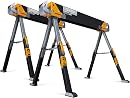 | Best Overall ToughBuilt C700 PairEditor's Choice  Check Price | Check Price |
 | Best for Uneven Surfaces Speedhorse XT PairCheck Price | Check Price |
 | Best Expandable Setup WORKESS Folding PairCheck Price | Check Price |
 | Best for Woodworking Kreg Track HorseCheck Price | Check Price |
 | Best Dual-Function Worx PegasusCheck Price | Check Price |
 | Best Budget BORA Workhorse PairCheck Price | Check Price |
1. ToughBuilt C700 Heavy-Duty Folding Sawhorses

The ToughBuilt C700 pair is what I reach for when the job calls for something more serious than holding up a couple fence pickets. Each stand is rated for 1,300 pounds — that’s 2,600 pounds as a pair — and the all-steel build puts it in a different class than the lightweight plastic horses many of us have tolerated for way too long. Framing lumber, sheet goods, doors, slab sanding, temporary work surface. This thing handles it.
The flexibility is what sold me. Adjustable legs for height, feet that help on uneven surfaces, and built-in support arms that accept 2x4s or 4x4s with a plywood top to make a jobsite table. That matters when I don’t want to drag out a full bench just to cut, paint, or stage materials. The pair folds down for storage and the carry handle helps, though let’s be realistic — this is still a steel tool, not a camp chair you toss in the trunk.
Main thing to know before buying: size and cost. The C700 leans more toward a wide work-table support than a narrow old-school sawhorse, so measure your storage space first. It’s also not the cheapest option on this list. But the capacity, adjustability, and 2-pack format make it a strong pick for anyone who wants saw horses that can handle real work without wobbling every time you breathe near them.
Pros:
- Very high load rating at 1,300 pounds per sawhorse and 2,600 pounds per pair.
- Steel construction gives it the solid feel I want for heavier shop and jobsite tasks.
- Works with 2x4s or 4x4s and plywood to create a broad temporary work table.
- Adjustable legs and folding design make it more versatile than basic fixed-height horses.
Cons:
- Costs more than many lighter-duty sawhorse sets.
- The wider table-style footprint may not be ideal if you need a narrow support setup.
2. Bora Portamate Speedhorse XT Adjustable Steel Pair

The Bora Speedhorse XT is the heaviest hitter in this lineup — 1,800 pounds per stand, 3,600 pounds as a pair. If the ToughBuilt C700 above is the serious option, this one is the “I’m not messing around” option. Steel build, planted feel, the kind of mass that keeps things from walking across the floor mid-cut.
The height range is the real differentiator here. Working anywhere from 30 to 36 inches in one-inch steps makes a noticeable difference if you’re switching between cutting, assembling, and general bench work. Even better, each leg adjusts independently. Real jobsites don’t happen on perfectly flat floors — rough driveways, yards, garage slabs with that annoying dip in the middle. This design gives you a way to level things out instead of wedging a shim under one leg and hoping for the best.
I have to be straight about one thing though. The leg release mechanism has a reputation for inconsistency — some units fold and deploy smoothly, others are fussy right out of the box. For what this pair costs, that’s a legitimate annoyance. When the mechanism cooperates, this is arguably the strongest and most adjustable set here. When it doesn’t, you’ll be reaching for a rubber mallet before the first board is cut. Bora also makes the PM-3350T I review at #6 — that one’s simpler, cheaper, and skips the adjustable-height hassle entirely if you just want sturdy folding steel horses without the bells and whistles.
Pros:
- Very high weight rating at 1,800 pounds per stand.
- Adjustable 30-36 inch working height helps match the task and the person.
- Separate leg adjustment is useful on uneven surfaces.
- Folds for storage and transport, with no assembly listed.
Cons:
- Heavier than basic folding sawhorses — portability takes a back seat to stability.
- Leg release mechanism may be inconsistent between units based on user reports.
3. WORKESS Steel Folding High-Capacity Pair

On paper, the WORKESS pair matches the ToughBuilt C700 at 2,600 pounds combined. In practice, it earns its spot for a different reason: the side hardware. Adjustable hooks that accept 2×4 lumber, fold-down supports for wider boards and panels, rotating leg bases for imperfect floors — this set wants to be more than just two legs holding up a plank.
The metal construction is the baseline appeal. These feel like jobsite gear, not weekend-only storage clutter. The folding setup is quick and painless — legs open and tuck away without turning the process into a wrestling match, and the carry handle keeps them manageable when moving between the truck and the garage.
Where the WORKESS falls short compared to the ToughBuilt is adjustable height — there isn’t any. You get what you get. And building out a proper workbench surface still means supplying your own lumber for the rails. But as a pair of steel folding horses with genuine expansion capability for wider setups, they slot in nicely for anyone who wants heavy-duty support without paying for the Bora Speedhorse XT’s adjustability features.
Pros:
- Strong 2,600-pound combined rating for demanding home shop and jobsite tasks.
- Steel build gives it a more durable feel than lightweight plastic-style stands.
- Folds down for easier storage and transport.
- Side hooks and fold-down supports add useful setup options beyond basic horse duty.
Cons:
- No height adjustment — what you get out of the box is it.
- To build out a larger workbench-style surface, you still need to supply the lumber.
4. Kreg KWS500 Adjustable Track Horse

This is the oddball on the list and I mean that as a compliment. The Kreg KWS500 isn’t really trying to be a traditional sawhorse — it’s a track-based work support with a built-in 3-inch clamp, and that clamping ability is what separates it from everything else here. Cutting, sanding, assembling, holding fussy pieces that normally need a third hand nature didn’t give you. This thing actually does that.
Steel and aluminum construction, six height positions, and a 2,200-pound combined capacity when you pair two units. Solid numbers. I use mine beside the table saw for outfeed support, under long boards, and as part of a larger temporary surface when the bench is already covered in another project’s mess.
The tradeoff is cost and some side-to-side play if you push laterally. Also, the side support brackets are separate loose pieces, and loose accessories in a busy shop have a talent for disappearing. None of the heavy-duty steel horses on this list — the ToughBuilt, Bora, WORKESS — offer real clamping capability, so if holding your work steady matters more than raw weight capacity, the Kreg fills a gap nothing else here covers.
Pros:
- Built-in track works well with the included clamp for holding material in place.
- Six height settings make it more flexible than a fixed sawhorse.
- Folds down for easier storage and hauling.
- Strong listed capacity when used as a pair.
Cons:
- Costs more than basic plastic or simple metal sawhorses.
- Adjustable design may have some side-to-side wiggle under lateral pressure.
5. Worx Pegasus Portable Work Support

The Worx Pegasus is a hybrid, and I think more people should know about it. It gives me a real tabletop for layout, sanding, paint prep, and small repair jobs, then switches into sawhorse duty when the load gets heavier. 300 pounds in table mode, 1,000 pounds as a sawhorse. That dual personality is the whole pitch, and honestly it works.
The 31-by-25-inch surface gives enough room for common weekend projects without eating half the garage, and the 32-inch working height is practical for cutting and assembly. At 30 pounds it’s portable but not dainty — that weight is part of why it feels planted instead of dancing around every time a saw starts up.
The included clamps and bench dogs are what push this from “nice idea” into “genuinely useful” territory. Holding boards, odd shapes, circular pieces while I work on them — way handier than a plain pair of horses where everything slides around. I wouldn’t trust the clamps for maximum-pressure glue-ups, but for everyday gripping and positioning, clever package. Bonus: it connects with compatible Worx tables if you need a larger setup. The Kreg KWS500 at #4 also clamps, but it’s more of a precision track system — the Pegasus is broader and better as a standalone workstation.
Pros:
- Works as both a compact work surface and a high-capacity sawhorse.
- 300-pound table rating and 1,000-pound sawhorse rating make it more capable than a basic folding stand.
- Included clamps and bench dogs add real usefulness for cutting, sanding, and holding awkward pieces.
- Folds down for storage, which is a lifesaver in a crowded garage or small shop.
Cons:
- At 30 pounds, it’s portable but not effortless to carry around a jobsite.
- The included clamps are handy for general work but won’t replace dedicated heavy-duty clamps.
6. BORA PM-3350T Steel Folding Pair

Second Bora product on the list, and deliberately so. Where the Speedhorse XT at #2 is the adjustable-everything premium option, the PM-3350T is the simpler, cheaper steel horse from the same brand. No height adjustment. No telescoping legs. Just open, lock, work, fold, done. Sometimes that’s exactly what you want.
Each horse is rated for 1,350 pounds, which is far beyond what most garage and shop work demands. The steel build feels planted, and for ripping sheet goods, supporting framing lumber, or setting up a temporary assembly station, I trust these more than any plastic option I’ve used. The single-latch folding setup is fast, and the pre-drilled 2×4 support points let me build out a useful work surface without committing to a full bench. Throw a sacrificial plywood top across a pair and the garage has a work table that disappears when the job is done.
Weight is the tradeoff. These are metal horses, so loading a pair in and out of a truck takes more effort than carrying featherweight stands. Keep fingers clear while folding the legs too — any hinged shop gear deserves respect. The built-in bottle opener is a funny touch, but that feature waits until the saw is unplugged and the day is done. If you looked at the Speedhorse XT and thought “I just need strong, simple, steel” — this is the one.
Pros:
- Very high listed capacity at 1,350 pounds per sawhorse.
- Steel construction feels appropriate for demanding carpentry and jobsite support.
- Folds down for storage and transport instead of eating up the whole garage.
- 2×4 mounting points make it easy to create a larger work surface.
Cons:
- Heavier than lighter-duty plastic saw horses — hauling them solo gets old.
- Folding hardware can pinch if handled carelessly.
Saw Horse Buyers Guide: What Actually Matters Before You Spend
You’ve seen the specific sets I recommend — now let’s talk about what to look for if none of those are quite right, or if you want to understand why I picked them. Fair warning: sawhorses look simple, and they are, but buying the wrong pair means wobbling, collapsing, or cussing your way through what should’ve been an easy project.
Material: Steel, Plastic, or Wood — Pick Your Poison
This is the single biggest decision, and it affects everything else — weight, durability, price, and how much cursing you’ll do hauling them around. Steel sawhorses are the tanks. They handle serious loads, last practically forever, and laugh at abuse. Every steel set on my list — the ToughBuilt C700, both Boras, the WORKESS — shares those traits. Downside? They’re heavy, they can scratch your workpieces, and if you leave them outside, rust becomes your new hobby.
Plastic horses (usually polypropylene) are the darlings of the weekend warrior crowd — light, stackable, surprisingly strong for their weight. But they flex under heavy loads and will crack if you leave them in a freezing garage long enough. Don’t ask how I know.
Then there’s the classic wooden sawhorse — site-built or bracket-and-2×4 style. A pair of well-made wooden horses is honestly hard to beat for a dedicated shop. You can screw into them, clamp to them, beat on them, and when they finally give up the ghost, burn them in the firepit and build new ones for almost nothing. If you primarily work in a fixed shop, wood sawhorses with metal brackets give you the best combination of customizability and value.
Weight Capacity: The Number Everyone Lies About
Every manufacturer slaps a weight rating on the box, and I’d take most of those numbers with a grain of salt the size of a golf ball. A “1,000-lb capacity” sawhorse usually means 1,000 lbs distributed evenly across a pair — so 500 lbs each, spread perfectly along the beam. That’s a far cry from dropping a wet 6×6 timber dead center on one horse. Real-world loads are almost never evenly distributed, and dynamic forces from sawing or hammering add stress no rating accounts for.
Buy sawhorses rated for at least twice the weight you actually plan to put on them. Mostly cutting 2x4s and sheet goods? A 500-lb-per-pair rating is fine. Framing work, scaffold planks, hardwood furniture projects? Minimum 1,000-lb pair capacity — ideally more. Look at how the ratings played out on my list: the Worx Pegasus handles 1,000 lbs in sawhorse mode, which is plenty for light-to-medium work, while the Bora Speedhorse XT hits 3,600 lbs combined for the heaviest jobs. For anyone using sawhorses as scaffold supports, OSHA’s horse scaffold guidelines specify that scaffolds must support their own weight plus four times the intended load, and they can’t exceed 10 feet in height. That’s a federal safety standard, not a suggestion.
Height and Adjustability
Standard sawhorse height lands around 32 inches, which works for most cutting and assembly tasks. But “works fine” and “works great for your back” are two different conversations. If you’re over 6 feet tall, you’ll be hunching over all day, and your lower back will let you know by Tuesday.
Some models offer adjustable legs or telescoping heights — the Bora Speedhorse XT gives you 30 to 36 inches in one-inch steps, and the Kreg KWS500 has six height positions. Sounds great, and it is great, as long as the adjustment mechanism stays solid. Cheap push-button pins get wobbly after six months of hard use.
One thing worth measuring: if you plan to throw a sheet of plywood or a solid-core door across your sawhorses as a temporary workbench, the finished height including that top surface needs to be comfortable. For most people, that’s 34 to 36 inches total. Measure your kitchen counter — that’s roughly the ergonomic sweet spot for standing work.
Folding vs. Fixed: Portability vs. Rock-Solid Stability
Folding sawhorses are what most people buy, and for good reason — they collapse flat, stack in the truck bed or hang on a shop wall, and set up in seconds. Every set I reviewed is folding. The tradeoff is that every hinge, pivot, and locking mechanism is a potential failure point. The best folding designs use metal-on-metal locking joints rather than plastic latches. I’ve had plastic latch mechanisms snap mid-project, and the resulting sawhorse collapse is both terrifying and hilarious — depending on whether it happened to you or your buddy.
Fixed sawhorses — the build-with-brackets-and-lumber kind, or welded from steel — don’t fold. They take up space. They’re annoying to transport. And they are unshakably stable in a way no folding horse can match. If you have dedicated shop space, build or buy a fixed pair for your primary work and keep a folding set for jobsites and overflow.
Top Beam Design: It’s More Important Than You Think
The top beam is where your workpiece actually sits, so its design matters more than people realize. Steel V-top beams cradle pipes and round stock well, but they’ll chew up the corners of finished lumber. Flat-top beams support sheet goods and wide boards better, but round stock rolls right off. Some horses — like the ToughBuilt C700 and BORA PM-3350T — let you use a 2×4 as the top beam, which is brilliant. You get a replaceable, clampable, screw-into-able surface that costs almost nothing to swap out when it gets chewed up.
Pay attention to whether the top beam has built-in clamp points, cord hooks, or speed squares. These features seem gimmicky in the store, but out on a project they save real time. The Kreg KWS500 takes this further than any other set here with its full track-and-clamp system — a couple of notches or holes for C-clamps can turn even a basic sawhorse into a surprisingly capable workstation.
Leg Spread and Stability
Here’s something people overlook until they’re chasing a sawhorse across the driveway: the wider the leg splay, the more stable the horse. A narrow stance saves floor space but makes the whole thing tippy, especially on uneven ground. Look for legs that angle outward in both directions — front-to-back and side-to-side. Some cheaper models only splay in one plane, which means stable on one axis but wobbly on the other.
Non-slip feet are non-negotiable if you’re working on concrete, tile, or any hard surface. Rubber or textured plastic foot caps prevent skating. Metal legs with no caps will slide on a smooth garage floor the instant you push a board through a saw, and that’s a safety issue, not just an annoyance. For outdoor work on soft ground, pointed or spiked feet dig in and hold better than flat ones.
Key Features Worth Paying For
- 2×4 support brackets — let you customize the top rail and legs with standard lumber, making repairs essentially free. Both the ToughBuilt C700 and BORA PM-3350T include these.
- Stackable or nesting design — critical if storage space is limited; some folding models collapse to 3-4 inches flat.
- Integrated tool shelf or cord management — small thing, big quality-of-life improvement during long cuts.
- Metal locking hinges — avoid all-plastic locking mechanisms on folding models if you value your kneecaps.
Safety: Don’t Be That Guy
Sawhorses seem low-risk, which is exactly why people get complacent. The Consumer Product Safety Commission tracks injuries from sawhorse collapses, tip-overs, and — my personal favorite — people standing on them like stepladders. A sawhorse is not a ladder. It is not a ladder. Treat it like one and physics will correct you, fast.
Always set up on level ground when possible. If you’re on a slope, shim the downhill legs — don’t just hope. Make sure both horses in a pair are the same height; mismatched heights create an angled work surface that lets boards slide and puts uneven stress on the stands. And if you’re ever using sawhorses as scaffold supports, OSHA requires the scaffold height not to exceed 10 feet, each horse must be placed directly over the one below, legs must be secured, and each tier must be crossbraced. This isn’t optional on a worksite — it’s federal regulation under 29 CFR 1926.452(f).