

We’ve all done it. You grab whatever tube is rattling around in the junk drawer, smear it on a cracked piece of plastic, clamp it overnight, and feel pretty good about yourself. Then the next day it pops right off like nothing ever happened. Now you’ve wasted a tube of glue, an evening, and a little bit of your dignity.
Here’s the thing nobody tells you. Plastic isn’t one material, and “glue” isn’t one product. The reason your repair failed probably has nothing to do with your technique and everything to do with chemistry. The best glues for plastic are the ones matched to the specific type of plastic you’re fixing, and once you understand that, your success rate goes way up.
So I’m going to walk you through which adhesives actually bond to which plastics, where the cheap stuff works fine, and where it’ll let you down. Stick with me and you won’t be standing in the hardware aisle guessing ever again.
Best Glues for Plastic in 2026
| Image | Model | |
|---|---|---|
 | Best for Hard Plastics Loctite Plastics Bonding SystemCheck Price | Check Price |
 | Best for Precision Loctite Super Glue Ultra Gel ControlCheck Price | Check Price |
 | Best Overall Gorilla Super Glue GelCheck Price | Check Price |
 | Best Gap Filler Gorilla Clear EpoxyEditor's Choice  Check Price | Check Price |
 | Best for Heavy Duty J-B Weld PlasticWeld 50133Check Price | Check Price |
 | Best for Rebuilding J-B Weld PlasticWeld PuttyCheck Price | Check Price |
 | Best for Models Tamiya Extra Thin CementCheck Price | Check Price |
What to Know Before You Buy Plastic Glue
Plastic is the trickiest material I bond, and it isn’t close. Wood drinks glue. Metal gives you texture to grab. Plastic just sits there, slick and smug, daring your adhesive to fail. Before you drop money on a tube or a kit, here’s what actually separates a repair that holds from one that pops loose the first time you stress it.
Plastic Type Compatibility
Not all plastics are created equal, and a few of them flat out refuse to bond with standard glue. The big offenders are polypropylene (PP), polyethylene (PE), and PTFE. These have low surface energy, which is a fancy way of saying glue can’t get a grip on them. You can sand, clean, and pray all you want, and a regular super glue will still peel off like a sticker.
To figure out what you’re dealing with, flip the part over and look for the recycling number stamped in the little triangle. A 5 is polypropylene. A 2 or 4 is polyethylene. If you see either, you need a primer-based system, not a standard adhesive. The Loctite Plastics Bonding System exists for exactly this reason. Its activator pen preps the surface at a molecular level so the glue has something to hold onto.
- PP, PE, PTFE: need a primer or specialty kit like the Loctite Plastics Bonding System
- ABS, PVC, polystyrene, acrylic: bond well with most glues, and the J-B Weld PlasticWeld handles these with ease
Bond Type: Structural vs. Surface
The first question I ask myself is simple: will this joint carry a load, or does it just need to stay put? That answer points you toward two very different categories of glue.
Structural repairs are anything that bears weight, takes stress, or flexes under use. Think a cracked bracket, a broken mounting tab, or an automotive part that vibrates all day. For those, you want a two-part system like the J-B Weld PlasticWeld or Gorilla Clear Epoxy. These cure into a rigid, load-bearing bond that won’t shear under pressure.
Surface and light-duty fixes are a different animal. A loose trim piece, a snapped figurine arm, a cosmetic crack that just needs to look whole again. A quality cyanoacrylate like the Loctite Super Glue Ultra Gel Control does the job fast and clean. Don’t trust a super glue with a load-bearing repair, no matter how strong the label claims it is. Match the glue to the stress, not to the marketing.
Set Time vs. Cure Time
This one trips up more people than anything else, so read it twice. When a label says “sets in 5 minutes,” that is not the same as full strength. Set time is your working window, the point at which the parts stop sliding around. Cure time is when the bond reaches its real, advertised strength, and that can take hours or even a full day.
Why does this matter so much with plastic? Because half the plastic repairs I do can’t be clamped. Curved surfaces, tiny tabs, awkward angles. You’re holding the part by hand or balancing it and hoping. A glue with a short set time, like the Loctite Ultra Gel, lets you let go sooner. A slower epoxy like Gorilla Clear Epoxy gives you more time to position, but you’ll be babysitting it.
Read the cure time and don’t stress the joint until it’s fully cured, even if the part feels solid early. I’ve ruined more than one repair by getting impatient and putting it back into service too soon.
Gap-Filling vs. Tight-Fit Joints
How clean is the break? That decides whether you need a glue or a filler. Cyanoacrylates need tight, mating contact to work. If the two pieces snap back together with no gap, a gel super glue like the Gorilla Super Glue Gel locks them in nicely. The glue line has to be thin.
But when chunks are missing, edges are crumbled, or you’re rebuilding a worn surface, super glue has nothing to bridge. That’s where an epoxy putty earns its keep. The J-B Weld PlasticWeld Putty mixes by hand into a moldable stick you can press into a void, shape, and even sand once it hardens. It fills space and bonds at the same time.
- Clean break, tight fit: super glue or thin epoxy
- Missing material or wide gap: epoxy putty like the J-B Weld PlasticWeld Putty
Finish Appearance
Sometimes nobody will ever see the repair. Sometimes it’s front and center on a toy, a model kit, or a piece of dashboard trim. The cure color matters more than people expect.
Some adhesives dry clear, and some cure to a tan or amber that stands out against lighter plastics. If looks count, reach for something that dries invisible, like the Gorilla Super Glue Gel. For scale models, the Tamiya Extra Thin Cement wicks into seams and welds the plastic together with almost no visible residue, which is why model builders swear by it.
Test your glue’s cured color on a hidden spot before committing it to a visible surface. A bond can be perfect and still look like a scar if the color clashes. For structural work hidden behind a panel, color doesn’t matter and you should pick for strength instead.
1. Loctite Plastics Bonding System
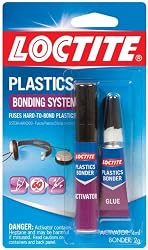
Polyethylene and polypropylene are the slippery cousins of the plastic world. You know the type. Storage bins, certain car bumpers, the cheap stackable patio chairs that crack at the worst moment. Standard super glue beads up and slides right off them like water on a waxed hood. That’s exactly the problem this Loctite kit solves, and it’s the reason it leads off my list.
The trick is the two-part setup. There’s an activator pen that you wipe on first, and it does something at the surface level to wake up those non-porous plastics so the glue can actually grab. Then you apply the cyanoacrylate, press the parts together, and it sets in seconds. No clamping. No mixing ratios to fuss over. It dries clear too, so a repair on something visible doesn’t look like you went at it with a glue gun.
Honestly, the activator is also the weak spot. The stuff is volatile and can dry out fast, sometimes before you even crack it open. So check it works before you count on it for an emergency fix. The glue tube can also clog and seal itself shut, which is a familiar super glue headache. And the kit is small. We’re talking minor repairs here, not rebuilding a kayak.
Both this and the Loctite Ultra Gel further down are budget cyanoacrylate systems, but this one handles the plastics that gel formula just can’t touch. I’d keep this in the toolbox specifically for PE and PP jobs and not much else. A quick tip: wipe the surface clean and dry first, then let the activator flash off for a few seconds before the glue goes on. It struggles with PVC and heavy stress loads, so don’t ask it to do the impossible.
For most everyday plastics that aren’t the slippery troublemakers, you can skip the activator dance entirely, and that’s where a straightforward super glue gel starts to make a lot more sense.
Pros:
- Bonds PE, PP, PTFE, nylon
- Sets in seconds, no clamping
- Dries clear and weatherproof
- Budget-friendly
Cons:
- Activator dries out fast
- Small kit, minor repairs only
2. Loctite Super Glue Ultra Gel Control

If your repair list is full of tiny plastic casualties, this is the Loctite I reach for. Snapped toy clips, a cracked hinge on the remote, a trim piece that popped loose in the car. The kind of jobs where one stray drip turns a clean fix into a sticky mess you regret for years.
The bottle is the whole story here. It’s a side-squeeze design instead of the usual tube you mash from the bottom, and honestly it changes how the glue lands. I get pinpoint placement without that sudden gush you fight with cheaper tubes. The gel itself sits exactly where I put it, even on a vertical surface, so nothing runs down into a spot I didn’t want glued.
It dries clear, which matters when you’re fixing something people actually look at. The bond shrugs off water, impact, and vibration too, so a repaired toy can take another round of abuse from a determined four-year-old.
Now the honest part. The bottle is tiny, smaller than you’d expect, so you’re not stocking up for big projects with this one. The bottle is opaque, so I never know how much is left until it sputters out mid-job. And the nozzle will clog if you don’t seal the cap perfectly every single time. Treat that cap like it owes you money. It also won’t grab rubbery, flexible plastics or anything sitting in constant heat and damp.
For fiddly, detailed work though, the control is hard to beat. I compared it side by side with Gorilla’s gel, and both keep the no-drip advantage, but Loctite’s bottle wins on placement accuracy for small parts.
Gorilla’s gel, on the other hand, has its own strengths once you move to bigger or rougher surfaces, which is where we head next.
Pros:
- Pinpoint side-squeeze control
- Gel won’t drip or run
- Dries fully clear
- Tough, impact-resistant bond
Cons:
- Very small bottle
- Nozzle clogs if cap left open
3. Gorilla Super Glue Gel

This is the tube I keep within arm’s reach on my workbench, honestly. Gorilla’s Super Glue Gel earns its spot because it does the one thing thin super glues can’t: it stays put. The gel formula doesn’t run off vertical surfaces, so when I’m gluing a snapped tab back onto an upright plastic housing, the glue waits for me instead of dribbling down onto my hands and the floor.
That thickness is the whole story here. Uneven joints, awkward angles, parts you can’t lay flat, this fills the role nicely. It grabs in 10 to 45 seconds with no clamping, which is a small miracle when you’re holding two pieces of plastic together and your patience is running thin. Dries crystal clear too, so repairs on visible plastic stay discreet.
I’ll line it up against the Loctite Ultra Gel Control, since they’re cut from the same cloth. Loctite’s bottle gives you a hair more precision, but you get a tiny amount of glue for the money. Gorilla hands you more product and the same no-drip behavior. The anti-clog cap is a nice idea on both, though I’ll be straight with you: mine started gumming up at the nozzle after the second or third use, cap or no cap. Wipe the tip and recap it fast, and you’ll stretch its life.
A couple of honest warnings. It won’t touch polyethylene or polypropylene, so check your plastic first. And go light. Too much gel actually weakens the bond and slows the set. This stuff bites skin instantly, so keep acetone nearby.
For general household plastic fixes that are upright, awkward, or mixed-material, it’s a reliable everyday pick at a budget price.
Fast and thin works for clean breaks, but cracks and gaps are a different animal. For those, you need something with real body to fill the void.
Pros:
- No-run gel on vertical surfaces
- Sets fast, no clamping
- Dries crystal clear
- Generous amount, budget-friendly
Cons:
- Nozzle clogs after a few uses
- Won’t bond PE or PP
4. Gorilla Clear Epoxy

Here’s where I reach when a plastic repair doesn’t sit flush. Broken brackets, cracked housings, parts with a visible gap between them. Regular glue just sits on the surface and prays. This Gorilla epoxy actually fills the void and cures into something structural, which is a different animal entirely.
The 5-minute set time is the headline for me. You mix, you position, and you’ve got just enough breathing room to nudge things into place before it grabs. I find that window honest, not generous. Don’t dawdle. The dual-barrel syringe pushes resin and hardener at a perfect 1:1, so no eyeballing ratios on a scrap of cardboard. It dries clear with a faint amber tint, which means repairs on lighter plastics don’t scream “I was broken once.”
Strength sits around 3300 PSI. That’s plenty for household plastic that needs to take a beating. Compared to J-B Weld’s PlasticWeld, which I get to next, Gorilla loses a little on raw tensile numbers but wins on cure speed and that clean finish. The J-B Weld cures tan, so it’s not your choice for anything you’ll actually look at.
The gripes are real. That syringe fights back. You’ll press one side harder than the other and get uneven flow, and if you don’t wipe the tip and cap it right, the cap bonds shut for good. Mine has oozed and made a mess more than once, so keep paper towels handy. The smell during mix is sharp too. Crack a window.
For the money, though? It’s a steal. Fast, strong, gap-filling, and cheap. Hard to argue with that combo.
Pros:
- Fills gaps with structural strength
- Fast 5-minute set
- Dries nearly clear
- Foolproof 1:1 dispensing
Cons:
- Syringe presses unevenly
- Messy oozing, strong odor
5. J-B Weld PlasticWeld 50133

If raw strength is what you’re after, this is the heavyweight on my list. J-B Weld’s PlasticWeld pulls a tensile strength of 3770 PSI, which is the highest number you’ll find here. For high-stress jobs like a cracked bumper, a busted piece of automotive trim, or a 3D print that needs to actually hold up under load, this is the one I reach for.
It’s a two-part urethane, and that chemistry matters. I keep comparing it to the Gorilla Clear Epoxy, another two-part formula in this roundup. The Gorilla tops out around 3300 PSI and cures fast, but urethane gives you a slightly higher strength ceiling and a bit more flex once it sets. On plastic that vibrates or sees impact, that flexibility is honestly worth more than a clear finish.
The dual syringe makes mixing brainless. Push out a 1:1 bead, blend it on the included tray, and you’re set in about 15 minutes. The resealable cap means I’m not throwing away half a tube after one repair, which is a small thing I appreciate more than I expected.
Now the honest part. It cures tan, so forget about invisible repairs on anything visible. Full cure runs 30 hours, so plan to leave it overnight and then some. And it won’t grab polypropylene without serious surface prep, which trips up a lot of folks. Read the directions and respect the cure time or you’ll get a weak bond and blame the glue.
For ABS, PVC, PETG, fiberglass, and coated metal, though, this thing is a tank. Strongest bonder here, no contest. But strength only matters when you’ve got two surfaces to join. When the plastic is straight up missing and you need to fill and rebuild, glue won’t cut it. That’s a job for putty.
Pros:
- Highest strength here, 3770 PSI
- Easy 1:1 syringe mixing
- Resealable for multiple jobs
- Broad plastic compatibility
Cons:
- Tan color, no clean repairs
- Long 30-hour full cure
6. J-B Weld PlasticWeld Putty

Here’s where things get interesting. Most glues on this list join two surfaces that already fit together. This J-B Weld putty does something different. It rebuilds plastic that’s gone missing. Snapped a mounting tab clean off? Got a chunk torn out of a bumper? You knead this stick by hand, press the putty into place, and shape new material where there used to be none.
I think of it as the sculptor in the family. You cut off a slice, work the two parts together until the color goes uniform, then mold it like clay. Once cured you can sand it, drill it, carve it, even paint it. That opens up repairs the liquid stuff just can’t touch.
Compared to the J-B Weld liquid bonder earlier in this lineup, the difference is reconstruction versus connection. The syringe adhesive lays down a thin permanent bond between mating parts. This putty fills voids and replaces broken geometry. Both grip ABS, PVC, CPVC, fiberglass and vinyl, so you’re really choosing based on the job in front of you.
It sets in about 25 minutes and fully cures in a couple hours. Honestly, the real working time feels closer to 15, so don’t dawdle once you start mixing. The consistency is sticky as taffy, which makes thin or precise work a pain. And the cured material ends up harder than the plastic around it, so sanding flush takes patience or you’ll dig a trench.
One nice surprise: it’s NSF-certified for potable water contact, so I’d trust it on a leaking plastic pipe fitting in a pinch. It won’t grab polyethylene or polypropylene, and under heavy vibration it can crack. For low to medium stress fixes though, it’s a budget-friendly problem solver.
So far everything here handles everyday household plastics. But scale modelers play by entirely different rules, and polystyrene kits need a glue built just for them.
Pros:
- Rebuilds missing plastic
- Sandable, drillable, paintable
- NSF-safe for water
- Budget-friendly
Cons:
- Too sticky for fine work
- Cracks under high vibration
7. Tamiya Extra Thin Cement

Calling this stuff glue feels almost wrong. Tamiya Extra Thin Cement doesn’t sit on top of your plastic the way an adhesive does. It melts into it. The cement chemically softens the polystyrene, fuses the two surfaces, and as it cures the parts become one piece. If you build scale kits or paint up a squad of Warhammer minis, that’s exactly what you want.
The trick is how it wicks. You dry-fit your parts, hold them together, then run the fine applicator tip along the seam. The cement draws right into the joint on its own. No glob to wipe away, no cloudy residue smeared across your paint job. Honestly the first time I watched it disappear into a hairline gap I was a little impressed.
This is where it parts ways with something like the Loctite Ultra Gel. Both promise precision on plastic, and both deliver it in their own lanes. But the Loctite only grips the surface. It bonds. Tamiya welds. For invisible joints on model plastic, surface bonding just can’t compete.
It’s not foolproof. The smell is heavy acetone, so crack a window or wear a mask. The consistency is water-thin, which means a heavy hand sends it running onto surfaces you never intended. And there’s a real learning curve. Apply it to both halves before joining and you’ll get a melted mess instead of a clean weld. Keep the cap on between uses too, since the open bottle keeps off-gassing.
You also get a generous working window. Plenty of time to nudge a part into place before it sets, which beginners will appreciate. The bottle gives you a lot of volume for budget pricing, and it stores well for a couple years if you seal it tight.
If you work in polystyrene, this is the one I keep on the bench. A fitting note to close on, since it’s the most specialized tool in this whole lineup and it earns its spot.
Pros:
- Welds plastic from inside
- Clean, invisible joints
- Generous working time
- Great value, long shelf life
Cons:
- Strong fumes, needs ventilation
- Steep learning curve
Which Plastic Glue Should You Actually Buy?
You’ve seen the contenders. Now let me cut through the noise and tell you exactly what to grab for your specific job. Match your situation to the list below and you’re done.
Your plastic says PP or PE on the bottom
Storage bins, garden chairs, those slick plastic tubs that laugh at every glue you throw at them. These polyolefin plastics are notoriously hard to bond because nothing wants to stick to them. Reach for the Loctite Plastics Bonding System. It’s the only product here that includes a primer to chemically wake up those slippery surfaces so the adhesive can actually grab hold.
You need a tiny, precise repair without the mess
A snapped toy clip or a hairline fix where one wrong drop ruins everything. Go with Loctite Super Glue Ultra Gel Control. The bottle puts the glue exactly where you aim it and nowhere else, which is a gift when you’re working in tight quarters.
You’re fixing a clean crack that fits back together flush
The break is clean, the pieces mate up nicely, and you just need them to stay. Grab Gorilla Super Glue Gel. The gel formula won’t run on vertical joints and handles slightly uneven surfaces without dripping all over your workbench.
The parts don’t quite line up and there’s a gap
When the pieces refuse to sit flush and you’ve got a void to bridge, you need something with body. Gorilla Clear Epoxy self-levels into gaps and cures hard with real structural backbone, all without emptying your wallet.
You’re tackling a high-stress structural repair
Cracked bumper, broken bracket, anything that has to survive vibration and load. This is a job for J-B Weld PlasticWeld 50133. It’s the toughest bond on this list and built specifically for plastic that needs to hold under serious pressure.
A chunk is missing and you have to rebuild the shape
Sometimes bonding isn’t enough because part of the plastic is simply gone. The J-B Weld PlasticWeld Putty stick fills the void, then sands and paints once it cures. You’re reconstructing the part, not just gluing it.
You’re building model kits or hobby miniatures
Scale models and tabletop minis live and die by clean seams. Tamiya Extra Thin Cement wicks into the joint and chemically welds polystyrene, melting the surfaces together into a seamless bond that super glue can’t touch. If you build kits, this belongs on your bench.
Still on the fence? Pick the scenario that sounds closest to your project and trust it. Any one of these will outlast the repair you’re worried about, as long as you match the glue to the job.
Frequently Asked Questions
Why won’t super glue stick to my plastic?
Some plastics have low surface energy, which is a fancy way of saying their surface repels the cyanoacrylate in super glue. Polypropylene and polyethylene are the usual culprits. The glue beads up, refuses to grab, and you walk away frustrated.
Flip the part over and check the recycling number in the little triangle, the same trick I covered up top. A #5 means polypropylene, a #2 or #4 means polyethylene. For those, reach for the Loctite Plastics Bonding System. It comes with a primer that preps the surface first, so the glue actually has something to hold onto.
What’s the difference between epoxy and super glue for plastic repairs?
Super glue is your speed option. It works best when two surfaces fit flush against each other and you want a fast, tight bond. The Gorilla Super Glue Gel is great for that kind of clean, snug repair.
Epoxy is the heavy lifter. It fills gaps, bridges uneven seams, and shrugs off more stress once cured. If your parts don’t mate perfectly or the repair takes real load, the Gorilla Clear Epoxy is the smarter call. Ask yourself two things: do the pieces sit flush, and how hard will this joint get worked? That answers it.
How do I get a stronger bond when gluing plastic?
Prep does most of the work. Wipe both surfaces with isopropyl alcohol to kill oils and dust. If the plastic is glossy, scuff it lightly with fine sandpaper to give the glue some bite. Then dry-fit the parts before you commit, so you know exactly how they line up.
Both the Gorilla Super Glue Gel and the Loctite Plastics Bonding System reward this kind of patience. And resist the urge to glob it on. More glue doesn’t mean a stronger hold, it just means a messier joint that takes longer to set.
Can any of these glues handle plastic that gets hot, like near a car engine or dishwasher?
The Loctite Plastics Bonding System is your best bet for heat, rated to handle around 300°F. That covers most engine-bay and dishwasher situations where things get warm but not extreme.
Most of the super glues here aren’t built for sustained heat. They’ll hold fine at room temperature and fail you near a hot manifold. Always read the cure specs before you trust a bond anywhere warm.
Is plastic model glue the same as regular super glue?
No, and it’s an easy mix-up. The Tamiya Extra Thin Cement is a solvent cement, not an adhesive. It softens the polystyrene on contact and fuses the two pieces into one. Super glue only grabs the surface.
That difference matters on a model kit. Cement chemically welds the joint, while super glue sits on top and can leave a chalky white haze plus a weaker seam. For styrene model work, stick with the cement.