

You grabbed a glue gun for one quick fix, and now the nozzle drips, the stand topples, and half the glue stick is wasted. Sound familiar? We’ve all been there, standing over a project with a stringy mess and burnt fingertips, wondering why something this simple went so sideways.
Here’s the thing. Most glue guns feel identical in the store, but they behave nothing alike once you put them to work. I’ve melted my way through cheap ones that clogged after ten minutes and pricey ones that promised the moon and delivered a puddle. So I set out to find the best glue gun for the kind of stuff we actually do on weekends, the craft-table detail work and the garage repairs that need to hold.
I’ll walk you through the ones that earned a spot on my bench and tell you exactly where each shines. No fluff. Just what stuck and what didn’t.
- Hot melt holds fast but not forever — for load-bearing joints see my wood glue picks.
Best Glue Guns in 2026
| Image | Model | |
|---|---|---|
 | Best Overall ROMECH Full Size Hot Glue GunEditor's Choice  Check Price | Check Price |
 | Best for School Projects and Small Fixes Krightlink 20W Mini Hot Glue Gun KitCheck Price | Check Price |
 | Best for Long Craft Sessions Surebonder CL-800FCheck Price | Check Price |
 | Best for Delicate and Tough Materials Gorilla Mini Hot Glue Gun KitCheck Price | Check Price |
 | Best Cordless for Anywhere WORKPRO Cordless Hot Glue GunCheck Price | Check Price |
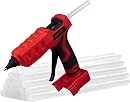 | Best if You Already Own 18V Batteries Mellif Cordless Glue Gun for 18V BatteriesCheck Price | Check Price |
 | Best for Precision Detail Work Surebonder CL-195FCheck Price | Check Price |
- I’d pick by project rhythm first: small dots need control, while long assembly runs need steady feed.
- For one bench gun that can cover a wide mix of home jobs, the ROMECH Full Size Hot Glue Gun is the practical middle ground.
- If the work moves around the garage, Mellif makes the most sense when you already keep tool batteries charged.
- A smooth trigger matters more than most folks think, because uneven feed makes lumpy beads and weak spots.
- For shared craft tables, I care just as much about where the hot gun rests between pulls as how fast it melts glue.
- If everything you do is away from an outlet, the battery models deserve their own look — I compared them in my cordless glue gun roundup.
What to Look for Before You Buy a Glue Gun
A glue gun is one of those tools that looks the same across the board until you use two side by side. One heats in 90 seconds and lays a clean bead. The other drools, cools fast, and pops your joint loose an hour later. The difference lives in a handful of specs most people skip right past on the box. Here’s what I check before anything goes in the cart.
Wattage and Heat Settings
Wattage tells you how quickly the gun melts glue and, just as important, how well it recovers after you pull the trigger a few times. Undersize it and the gun feels weak, stringy, and slow, which is the single most common reason a glue gun ends up abandoned in a drawer.
- 10 to 20 watts: paper, foam, fabric, detail work, short beads
- 40 to 60 watts: general household use and fuller glue flow
- 80 to 100 watts: wood, plastic, denser materials, longer runs, faster recovery
Then there’s the temperature question. Single-temp guns run hot all the time, which is great for hardwood and terrible for foam board that melts before the glue does. Dual-temp models let you drop to a lower setting for heat-sensitive materials. If you work with both delicate crafts and heavy repairs, buy a dual-temp gun and skip the guessing. The ROMECH Full Size Hot Glue Gun covers this with a 60W setting at 300°F for ribbon and a 100W setting at 410°F for structural bonds, so one tool spans both ends.
Corded vs. Cordless
Corded guns give you unlimited runtime and steady heat. Plug in, wait for warmup, and go until the job’s done. The trade-off is obvious: you’re tethered to an outlet, and that cord has a way of dragging fresh glue across your workpiece.
Cordless models buy you freedom, and how they get there changes everything about who they suit. There are three routes, and picking the wrong one is how people end up disappointed.
Some carry an internal battery you recharge over USB, like the WORKPRO Cordless Hot Glue Gun with its Type-C port. The battery lives in the tool, it tops off from the same brick as your phone, and you owe nothing to any brand. That’s the simplest cordless path if you don’t own power tools.
Others run off 18V tool batteries you already own. The Mellif Cordless Glue Gun comes in versions built for Milwaukee, DeWalt, or Makita packs, so you pick the one that matches the batteries already sitting on your charger.If your garage already looks like a battery collection, this is free runtime sitting on a shelf.
The third route skips the battery entirely. The Surebonder CL-800F heats on a docking base, then works untethered in short bursts. It stays feather-light in your hand because there’s no lithium pack in the handle, which your wrist notices after an hour at the craft table. The trade is runtime measured in minutes, not hours.
- Corded: unlimited runtime, best for long bench sessions and heavy bonding
- Internal-battery cordless: go anywhere, no platform needed, recharge by USB
- Tool-battery cordless: most power, best if you already own 18V packs
- Dock-heated cordless: lightest in hand, short bursts, easiest on your wrist
Glue Stick Size Compatibility
Glue sticks come in two common diameters, and your gun only takes one. Full-size sticks measure 7/16 inch and push out more glue per pull, which speeds up big jobs and holds heavier parts. Mini sticks run 5/16 inch and give you finer control for detail work and small crafts.
Availability leans toward full-size in most hardware aisles, though minis are everywhere in craft stores. Match your gun to the stick size you can actually find nearby, or you’ll be ordering refills online every few weeks. Think about project scale here too. Gluing trim to a cabinet with a mini gun is a slow, drippy afternoon you don’t want.
Mini vs. Full Size
Size is not just about the stick it takes. A mini gun is lighter, warms faster, and slips into tight corners, which is why it wins for jewelry, models, ribbon, and anything you do while leaning over a craft table. It also runs out of heat sooner on a long pass.
A full-size gun carries more heat and pushes more glue per pull. That matters when you’re bonding trim, foam board, upholstery, or anything structural. Buy the size that matches your heaviest realistic job, not the one you do most often. A mini gun on a cabinet repair is a slow, frustrating afternoon. A full-size gun on a rhinestone is a mess you can’t undo.
Safety Features
A glue gun runs somewhere between 250 and 400 degrees, and molten glue sticks to skin before you can flick it off. Two features are worth insisting on: an insulated or shrouded nozzle, so a stray knuckle doesn’t find bare metal, and a stable stand that keeps the hot tip pointed away from your hand.
Auto-shutoff is the third one I look for, especially if kids are anywhere near the table or if you’re the type who walks away mid-project. A gun that cools itself after a few idle minutes is one fewer thing to remember.
Drip Control and Nozzle Design
Every glue gun oozes a little as it heats and cools. The good ones ooze less. An anti-drip nozzle uses a check valve or a tighter tip to hold glue back between pulls, which saves you the cobwebby strings that end up on your table, your pants, and occasionally your fingers. The Krightlink Mini Kit and the Gorilla Mini Kit both use precision anti-drip tips that keep beads where you aim them.
Nozzle shape drives accuracy. A fine tip lets you run a clean line along a seam. A wider tip dumps glue fast for coverage jobs. The Surebonder CL-195F pairs an extended fine tip with cordless mode, a smart combo for detailed repairs.
Look for an insulated or shrouded nozzle, because a bare metal tip at 380 degrees finds skin faster than you’d believe. Molten glue burns hurt, and the guard is cheap insurance.
Stand and Stability
The kickstand is the part nobody thinks about until a hot gun tips off the bench and rolls toward the floor trailing glue. A wide, low stand keeps the gun planted while it heats. A skinny wire flip-out on a nose-heavy gun is an accident waiting to happen.
Set the gun down on a flat surface before you buy, if you can, and give it a gentle nudge. It should stay put with the nozzle tilted up and away from your hand. Budget guns cut corners here more than anywhere else, so this is worth a hard look.
Included Accessories and Value
The sticker on the gun isn’t the real cost. A bare gun means a separate run for glue sticks before you can do a single thing, and those add up. Kits that bundle refills and storage get you working the day the box arrives.
Here’s what genuinely lowers the true cost of starting out:
- A starter pack of glue sticks, ideally 20 or more
- A carry or storage case that keeps the cord and sticks together
- Extra nozzles or a finger guard for safer handling
The Krightlink and Gorilla kits both ship with 30 sticks, so you’re not stalled at the register. The ROMECH throws in a zip-up case, which keeps the whole setup from turning into a drawer of tangled parts. A bundled case pays for itself the first time you don’t have to hunt for your glue sticks.
1. ROMECH Full Size Hot Glue Gun

If you want one glue gun to cover a Saturday’s worth of odd jobs, the ROMECH is the first one I’d hand you. It’s a full-size gun that lives in a zip-up Oxford case, so it doesn’t end up rattling loose in a junk drawer with dried glue on the tip. That case alone sold me. It holds the gun, the sticks, and even the longer 7/16″ sticks, which means grab-and-go stays organized.
The real trick here is the dual power toggle. Flip to 60W at 300°F for foam, fabric, and delicate craft work where a hotter tip would scorch. Flip to 100W at 410°F when you’re gluing wood trim or something heavier that needs a faster, thinner flow. Being able to switch mid-project without swapping tools is genuinely useful when your afternoon jumps from repairing a picture frame to sticking down loose molding.
Heat-up is quick and the brass nozzle stays clean, with almost no drip when it’s sitting idle. I appreciate the on/off switch too. No more yanking the plug every time you step away.
Now the honest part. The folding stand is tippy, so I rest it on the edge of a scrap board instead of trusting it. The wattage tested a bit under what the box claims, and while the listing brags about 21 sticks, you get closer to ten usable ones. Stock up before a big job. This is a home and hobby gun, not something I’d run all day on a job site.
Compared to the Surebonder CL-800F, another budget full-power pick, it comes down to what you value. The Surebonder gives you a few minutes of cordless freedom off its heated base. The ROMECH trades that for dual-temp flexibility and better storage. For mixed light-to-medium projects, I lean ROMECH.
It handles most of what a weekend brings. But some days you just want a cheap little gun for a two-minute fix, and that’s a different tool entirely.
Pros:
- Dual 60W/100W temp toggle
- Included zip-up storage case
- Clean drip-free brass nozzle
- Fast heat, on/off switch
Cons:
- Wobbly built-in stand
- Fewer usable sticks than listed
2. Krightlink 20W Mini Hot Glue Gun Kit

Let me set expectations right away: this thing is tiny. One reviewer joked it looked like a glue gun built for ants, and honestly that’s fair. But for what it costs, the Krightlink surprised me. It heats up in a minute or two thanks to the PTC ceramic element, and the precision nozzle lays down a clean bead without that annoying string of drool most cheap guns leave behind.
For small crafts, jewelry fixes, or gluing felt onto a school diorama at 9pm the night before it’s due, this is plenty. The compact body sits nicely in your hand and I never felt cramped after a long session.
Compared to the Gorilla mini, which also ships with 30 sticks, you’re trading brand trust and dual-temp control for a rock-bottom price. The Gorilla feels sturdier. But the Krightlink does the same light work for less.
The kickstand is wobbly, and it eats those mini sticks fast on anything bigger. Watch the nozzle too. It bites.
If you’d rather ditch the cord entirely and still get real bonding muscle, Surebonder’s CL-800F pulls off a smart trick worth a look.
Pros:
- Heats in 1-2 minutes
- Clean anti-drip nozzle
- Rock-bottom price
Cons:
- Too small for big jobs
3. Surebonder CL-800F

The Surebonder CL-800F solves the cordless problem in a way I appreciate: it skips the internal battery entirely. Instead of hauling a lithium pack around in the handle, the gun charges on a heated docking base and stays feather-light in your hand. If you glue for an hour at a stretch, your wrist will thank you for that choice.
Here’s how the trick works. Sit the gun on its warming base, pull it off, and you get roughly 3 minutes of cord-free gluing before the heat starts to fade. That’s a tight window, so I think of it less as “cordless” and more as “tether-free bursts near your bench.” For a teacher moving down a row of desks or a crafter gluing a batch of ornaments at a station, that’s plenty. For a big project across the garage, you’ll want the cord plugged in, which it does indefinitely.
The 60W element and 380°F output punch above the budget price. I’ve had it bite into wood, metal, and ceramics without the weak tack you get from cooler mini guns. It heats fast, and the glue keeps flowing during long pumps.
Compared to a USB-C rechargeable like the WORKPRO, the philosophies split cleanly. WORKPRO gives you longer untethered runtime but a battery that ages; the Surebonder trades runtime for zero charging downtime and no dead cell to worry about.
My gripes are all about the dock. It’s so light it lifts off the table when you grab the gun, and reseating it often takes two hands. The drip clip feels flimsy too. Run it too long and it can overheat and drool.
Gorilla is a name most of us already trust, so let’s see how their mini holds up next.
Pros:
- Lightweight, battery-free handle
- Strong 380°F multi-material bond
- No charging downtime
Cons:
- Dock lifts and reseats awkwardly
- Only ~3 minutes cord-free
4. Gorilla Mini Hot Glue Gun Kit

Gorilla earned its name making adhesives, so it makes sense the brand puts that know-how into a hot glue gun. This mini kit trades on that reliability, and for the most part it delivers. The dual-temp switch is the real reason I reach for it. Low heat handles foam, ribbon, and dried flowers without melting them into a puddle; high heat locks down wood, metal, and glass. Flip the switch based on the material and you stop guessing.
The precision nozzle earns its keep on fiddly work. Beading glue along a picture frame or spot-gluing fabric, I get a clean line without stringing everywhere. And the weather-resistant sticks matter if your crafts head outdoors. I glued garden markers and a wreath that lived on the front door through rain, and both held.
Compared to the budget Krightlink mini, you’re paying more here, but you get the dual-temp control and Gorilla’s tougher glue formula the cheaper gun skips. Against the full-size ROMECH, this Gorilla stays compact and lighter, better suited to detail work than heavy sealing.
Honestly, it’s not built for daily professional abuse. The body feels light, and if that internal fuse ever blows, the whole thing goes in the trash. The built-in stand also drips a little, so keep a paper towel handy. For weekend crafting, though, it’s a dependable pick.
The catch is the cord. If you want real freedom to roam, WORKPRO’s rechargeable gun claims up to an hour off the leash.
Pros:
- Dual-temp for delicate and hard materials
- Precision nozzle for detail work
- Weather-resistant bonds hold outdoors
5. WORKPRO Cordless Hot Glue Gun

If you’ve ever tried to hot-glue a wreath while dragging a cord across the dining table, the WORKPRO makes a strong first impression. No dock, no external battery pack, no cable tethering you to the wall. It charges over USB-C from the same brick that tops off your phone, and that alone puts it in a different league than the Surebonder CL-800F, which only gives you about three minutes untethered before you’re back on the heated base. Sixty minutes of real cordless runtime here means I can actually finish a project before thinking about power.
The 30-second preheat is the part I keep coming back to. Most cordless guns make you wait. This one is ready before I’ve cut my first stick. Glue flows at about 5g a minute, so filling a bead goes quicker than I expected, and the nozzle doesn’t dribble a trail across my work like cheaper guns do.
Now the honest part. Battery longevity worries me. It’s a sealed built-in cell, so when it fades you can’t swap it. Let the charge run flat and low-voltage protection can brick the gun for good, which means you really do need to top it off after each session. It also won’t run reliably plugged in, and it only eats mini sticks. Compared to the Mellif, which taps existing 18V packs, the WORKPRO trades long-term flexibility for a cleaner all-in-one design.
For mobile crafters who charge diligently, it’s a fine pick. Just baby that battery.
Pros:
- 30-second preheat
- USB-C charging anywhere
- 60 minutes cordless runtime
- Fast, low-drip output
Cons:
- Sealed battery can fail permanently
- Mini sticks only, no plugged-in use
If you already own a shelf of Milwaukee, DeWalt, or Makita packs, there’s a gun that skips the built-in battery gamble entirely and runs off what’s in your garage.
6. Mellif Cordless Glue Gun for 18V Batteries

This Mellif fills a weird hole on the bench. Milwaukee sells mountains of cordless tools, yet this budget glue gun is the one that finally lets those same batteries do something on the craft table. The version linked here is built for Milwaukee 18V packs, though it’s worth knowing the product page lets you switch to a version made for other brands like DeWalt or Makita, so you can match whatever packs are already sitting on your charger. That flexibility is the whole pitch, and it’s a smart one.
For weekend repair work, the cordless setup is the point. I can carry it out to the porch for loose trim, into the garage for foam or fabric, or across the room during a craft project without dragging an extension cord behind me like a shop gremlin. Once a battery clips on, it also gives the gun enough weight to stand upright on its own, which beats balancing a hot nozzle on a scrap of cardboard and hoping for the best.
Warmup takes 3 to 5 minutes and the indicator light keeps it simple. Red means wait. Green means glue. Follow that religiously, because pulling the trigger too early can damage the feed mechanism. That’s not a cute little quirk, it’s the kind of mistake you make once and remember forever.
Output holds steady at roughly 0.63 ounces per minute, which is plenty for crafts, cardboard, decorations, and general bench fixes. I wouldn’t pick it for long production runs where a corded full-size gun just keeps dumping glue faster. The trigger feed can also slip, so now and then a second pull is needed to move the stick along. Annoying, yes. A deal breaker for light and medium DIY work, no.
Treat the included sticks as starter material. For anything that needs to hold, run better third-party sticks instead. The tool is only as good as the glue melting through it, and bargain sticks can make a decent gun look worse than it is.
Here’s the catch worth understanding before you buy. The WORKPRO carries its own rechargeable battery and tops off over USB-C, so it doesn’t care what tools you own. That makes it the easier call for a first-timer, since a bare Mellif plus a battery and charger bought separately can cost more than the gun itself. But if those 18V packs are already part of your routine, Mellif gives you more muscle and longer runtime for less money.
If you want to swing the other direction toward fine control instead of raw cordless power, Surebonder’s fine-tip model is worth a look next.
Pros:
- Runs on 18V packs you already own
- Version available for DeWalt or Makita
- Clear LED ready indicator
- Stands upright on battery base
Cons:
- Battery and charger cost extra
- Trigger feed can slip
7. Surebonder CL-195F

If your projects involve tweezers and magnifying glasses, this is the gun I’d hand you. The Surebonder CL-195F wears an extended fine tip that puts glue exactly where you want it, and nothing else on this list comes close for detail work. Placing a rhinestone on a pendant, gluing a scale-model railing, dotting adhesive under a tiny diorama figure? The tip reaches into spots where a fat nozzle just smears.
Compare it to the Krightlink mini or the Gorilla mini, both fine little guns with decent precision nozzles. But their tips are standard mini shape. This one is longer and narrower, so you get real line-of-sight control and less risk of touching your workpiece with a hot metal edge you can’t see past.
The cordless trick is handy for reaching across a project without a cord dragging through your beads, though you get maybe two minutes before it needs the stand again. Work fast. The base grips too tight and I found myself steadying the stand with one hand to pull the gun free. It only takes 5/16″ mini sticks, and output per squeeze runs light, which honestly suits delicate work fine.
For fine placement on a budget, I’d buy it. A fitting note to close on: the right tool makes small work feel easy.
Pros:
- Extended fine tip for precision
- Cordless off the base
Cons:
- Base grips too tight
- Only ~2 min cordless
Which Glue Gun Should You Get? Quick Recommendations
You’ve seen the lineup. Now let me save you the mental gymnastics and match a gun to how you actually work.
The one gun for almost everything
If you’re a weekend crafter who bounces between projects and wants a single tool that keeps up, get the ROMECH. Two power settings, a real carry case, and full-size output mean it handles the widest slice of your home projects without complaint.
Cheap and cheerful for school and quick fixes
Sometimes you just need something that works and doesn’t cost much. The Krightlink is ready in a minute or two and arrives with a pile of sticks, which makes it the easy pick for school projects and light repairs around the house.
Working where there’s no outlet
Out in the garage or a corner of the shop with no plug in reach? Grab the Mellif. It runs on the same 18V batteries your other tools already use, so there’s no charging wait and no real limit on runtime as long as you’ve got a spare pack.
Detailed, fiddly, precision work
Jewelry, dioramas, rhinestones, tiny parts that fight back. This is where a standard nozzle lets you down. The Surebonder CL-195F and its extended fine tip give you pinpoint control that a fat nozzle simply can’t match.
A classroom or shared craft table
When a dangling cord across a busy table is an accident waiting to happen, go cordless the simple way. The Surebonder CL-800F warms on a dock and works in short tether-free bursts, staying light in the hand and ready without any battery fuss.
Long bench sessions with no interruptions
If you settle in for hours and hate stopping to recharge anything, stay corded. The Gorilla Mini Hot Glue Gun gives you dual temp, that tougher Gorilla bond, and enough sticks to keep the momentum going.
Still torn? Pick the scenario that sounds most like your Saturday and buy that one. You can always add a second gun later, and honestly, most of us do.
Frequently Asked Questions
What’s the difference between a full-size and a mini glue gun?
It comes down to stick size and glue output. Full-size guns like the ROMECH take 7/16″ sticks and push more glue with every trigger pull, so they cover bigger seams and bond faster. Minis like the Gorilla and Krightlink run on skinny 5/16″ sticks and weigh less in your hand.
If you’re gluing shelf trim or repairing furniture, go full-size. For beading, ribbon, or fiddly craft work where you want to steer a small bead of glue exactly where it goes, a mini wins.
How long does a cordless glue gun last on a single charge?
All over the map. WORKPRO claims up to 60 minutes of runtime. The Surebonder CL-800F gives you around 3 minutes off its dock before it needs to reheat, and the CL-195F runs closer to 2. The Mellif rides entirely on whatever battery you slot into it, so a bigger amp-hour pack buys you more time.
My advice: keep a charged spare battery around, or work close enough to the dock that you can set the gun down between beads.
Do I need high-temp or low-temp glue for my project?
High temp runs 380°F and up. It grips wood, metal, and ceramic and holds under stress. Low temp sits around 250°F and won’t scorch delicate stuff like foam, thin fabric, or ribbon. Low temp is also the only safe setting on thin plastics, which soften before the glue grabs — my glue for plastic guide covers cold alternatives for those.
If your projects jump between both, a dual-temp gun saves you buying two tools. The ROMECH and the Gorilla both let you flip between settings.
Why does my glue gun drip so much?
Three usual suspects: the gun runs too hot, the nozzle is worn out, or it never had an anti-drip valve to begin with. A brass drip-free nozzle like the one on the ROMECH cuts the mess, and the Krightlink’s anti-drip design does the same.
The easiest fix costs nothing. Turn the gun off or unplug it during long pauses. A cooling nozzle stops oozing on its own.
Can I use any brand of glue stick in my glue gun?
Mostly yes, as long as the diameter matches. Full-size guns need 7/16″ sticks, minis need 5/16″, and most standard sticks in those sizes will feed fine.
One catch: the low-temp sticks that ship with the Mellif tend to clog the barrel, so I’d swap in third-party sticks. And always match the stick’s temperature rating to your gun so it melts clean instead of gumming up.
Are glue guns safe for kids to use?
With an adult nearby and a low-temp setting, yes. Look for an insulated nozzle and auto-shutoff. The Surebonder models and the Gorilla both shield the tip so small hands stay away from the hot metal.
Skip the Krightlink for young kids. Its nozzle sits exposed, which makes an accidental touch too easy.