

You notice a dark spot on your basement ceiling, or your freshly delivered lumber looks suspiciously heavy, and suddenly you realize you’re guessing instead of measuring. That guess can cost you. A wet stud you didn’t catch turns into rot. A floorboard laid over damp subfloor cups and buckles months later, long after you’ve patted yourself on the back for a job well done.
I’ve chased enough phantom leaks and warped panels to know that eyeballing moisture is a losing game. The trick is picking the right tool for the surfaces you actually touch. That’s where finding the best moisture meter gets interesting, because the answer isn’t the one with the longest spec sheet. It’s the one that reads your drywall, your framing, or your firewood the way you need it read.
Pin or pinless. Quick check or lab-grade precision. Cheap or serious money. Each choice points you toward a different meter, and picking wrong means either overpaying or trusting a number that lies to you. Let me walk you through what matters before you hand over your money.
Best Moisture Meters in 2026
| Image | Model | |
|---|---|---|
 | Best Overall General Tools MMD4EEditor's Choice  Check Price | Check Price |
 | Best for Leak Mapping Klein Tools ET140Check Price | Check Price |
 | Best for Flooring Pros Wagner Orion 910Check Price | Check Price |
 | Best for Inspection Reports Protimeter MiniCheck Price | Check Price |
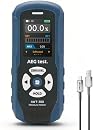 | Best for Moisture Checks AEGTEST AWT-380Check Price | Check Price |
 | Best Budget for Mixed Wood Mecurate Digital Moisture MeterCheck Price | Check Price |
- I sort these meters by consequence first, because a warranty floor, a leak map, and a firewood pile do not call for the same tool.
- For finished walls where speed matters, the Klein Tools ET140 is the cleanest example of a scan first meter that helps me trace the wet edge fast.
- If the reading may end up in a report, I want proof checks and a known pro track record before I care about extra screen features.
- Budget meters are fine for a wet or dry call, but I would not use them to settle flooring specs or serious drying records.
- The better buy is the meter that fits your messiest common job, not the one with the longest feature list.
How to Choose the Right Moisture Meter for Your Projects
A moisture meter is one of those tools that sits in the drawer for months, then saves you from a five-figure mistake in a single afternoon. Buy the wrong one, though, and you’re chasing numbers that don’t mean anything. Here’s what separates a meter you’ll trust from one you’ll toss.
Pin vs. Pinless Sensing
Pin meters drive two metal probes into the material and measure electrical resistance between them. That gives you a reading at a specific depth, right where the pins bite. They’re precise, they work in tight corners, and they let you check a floor joist an inch below the surface. The catch is those tiny holes. On a finished hardwood floor or a coat of fresh paint, that’s a problem.
Pinless meters use a sensor pad that reads through the surface without punching anything. You lay it flat, and it scans a shallow zone below. No damage, fast sweeps across a wall, ideal for hunting a leak behind drywall you don’t want to perforate. The trade is depth control and pinpoint accuracy. Pinless readings average across a broader area, so a small wet spot can get diluted in the number.
If you test finished surfaces, cabinets, or flooring you plan to keep pretty, go pinless. If you work with raw lumber, framing, or subfloor where a couple of pinholes vanish into the grain, pins give you cleaner data. The General Tools MMD4E covers the pin side well, and a pinless unit like the Klein ET140 handles the no-mark jobs. Plenty of pros own one of each.
Material Modes and Calibration
Water conducts the same everywhere. Wood, drywall, and concrete do not. A reading of “18%” means soaked in oak but bone dry in a chunk of masonry. A meter that doesn’t know what it’s touching just hands you a raw resistance number dressed up as a percentage.
Good meters offer dedicated material modes. Wood, sometimes broken down by species, then a reference or relative scale for drywall and masonry. Species matters more than people expect. Dense hardwoods and light softwoods conduct differently at the same moisture content, so a meter with species settings, or scales for dozens of wood types like the Mecurate offers, gives you numbers you can actually act on.
Match the mode to the material before every reading, not once at the start of the day. The Massachusetts Department of Public Health guidance on evaluating water damage in buildings is worth a skim if you’re doing any leak or flood assessment, since it explains how to interpret ranges instead of trusting a lone number.
Accuracy and Repeatability
Budget meters usually claim something like ±3% or ±4%. That’s fine for a go, no-go decision. Is this board too wet to finish? Is this wall wetter than the one next to it? A cheap meter answers those questions. Professional units tighten that tolerance and validate it against reference methods, the way standardized testing in NIST Handbook 159 checks meters against oven-dried samples.
Here’s the part people miss. For tracking drying progress, repeatability beats absolute accuracy. If your meter reads 2% low every single time, it still tells you the truth about whether a board is drying, because 14 today and 11 next week is real movement. A meter that jumps around from reading to reading on the same spot is useless for that.
Test repeatability yourself: press the meter on one spot three times and see if the numbers hold within a point. If they scatter, don’t trust it for kiln-drying decisions or moisture logs. Woodworkers waiting for stock to hit 6 to 8% need that consistency more than they need a lab-grade absolute figure.
Display and Readout Style
Three common readouts, three different jobs:
- Numerical percentage gives you the exact figure. Non-negotiable for woodworking, where you’re chasing a specific threshold before glue-up — most wood glue formulas want stock under 12% — or before finish.
- Color-coded LEDs flash green, yellow, or red. Fast, glanceable, perfect for sweeping a wall to find where the wet zone starts.
- Bar graphs land in between, showing relative wetness without demanding you read a tiny number in a dark crawlspace.
The best meters give you more than one. The Klein ET140 shows a percentage and a color-coded LED bar at the same time, so you get the precise number when you need it and the instant read when you’re moving fast across a ceiling looking for the source.
Think about where you’ll use it. Crawlspaces, attics, and dim basements reward a backlit screen or bright LEDs. A number-only display you can barely see does you no favors under a house at dusk.
Power Source and Longevity
Most meters run on a 9V or a couple of AAA batteries. Disposables are cheap and easy to swap in the field, and you’ll never wait for a charge. USB-C rechargeable units, like the AEGTEST AWT-380, skip the battery aisle and often pair with a color screen and data logging, which sips more power than a basic LCD.
Two features prevent the worst surprise, a dead meter halfway through a job:
- A low-battery indicator so you’re not questioning whether the low reading is the wall or the dying cell.
- Auto-off to keep the meter from draining in your tool bag after you forget to shut it down.
For a rechargeable meter, throw a power bank in your bag; a dead battery with no wall outlet in a crawlspace ends the inspection. Disposable-battery meters win for the tool you use twice a year and want ready the moment you grab it.
Build Quality and Included Accessories
Pins bend and break. That’s their nature. A meter that ships with spare pins keeps you working instead of ordering parts mid-project. The MMD4E includes replacement pins and a battery in the box, which is more than most budget meters bother with.
A calibration checker earns its keep. It’s a small block or cap with a known resistance that lets you confirm the meter still reads true. For anyone whose findings might get questioned, an inspector or a contractor documenting a moisture problem, that check is the difference between a number and evidence. The Protimeter Mini pairs its check device with a long professional track record, and the Wagner Orion 910 goes further with on-demand field calibration so you’re not shipping the tool back to the factory.
A carry pouch sounds trivial until you find your meter rattling loose against a wrench, sensor pad scratched. Prioritize a meter that includes a calibration checker and spare pins over one that just claims a slightly tighter accuracy spec. The extras keep the tool field-ready and save you three separate purchases down the road.
1. General Tools MMD4E

If you’re buying your first moisture meter and don’t want to overthink it, the General Tools MMD4E is where I’d start. I’ve handed this thing to friends who’d never held a moisture meter before, and inside a minute they were poking drywall and reading numbers off the backlit screen. That’s the whole appeal. It doesn’t ask much of you.
What sold me is the dual-mode setup. One mode reads wood from 5 to 50 percent, the other handles building materials like drywall and concrete down to 1.5 percent. So a single tool covers checking firewood before you burn it, chasing a suspicious ceiling stain, and confirming whether a subfloor has dried out after a leak. Three jobs, one meter.
The audible alert is the feature I didn’t know I wanted. Low, medium, and high tones mean I can jab the pins into a spot behind the water heater without craning my neck to see the display. Pair that with the HOLD button and you’ve got genuine one-handed operation in tight corners. The Mecurate leans on a wider spread of wood-type scales, which matters if you’re a serious woodworker chasing exact species readings. But it skips the beeper, and the tones are what make the MMD4E faster to work with day to day. The MMD4E also ships with a battery, spare stainless pins, and a cap that doubles as a calibration checker, so you’re testing the moment the box opens. That’s more out-of-box value than most budget meters bother with.
Two honest gripes. Accuracy sits at plus or minus 3 percent, fine for homeowners but not lab work. And it gets finicky pointing straight up, sometimes resetting on ceiling checks. Keep the pins firmly seated and you’ll dodge most of that.
If those little pin holes make you wince, the next pick skips them completely.
- Dual wood and building modes
- Audible high/medium/low alerts
- Battery, spare pins, cap included
- Simple one-handed operation
- Leaves small pin holes
- Flaky on overhead readings
2. Klein Tools ET140

If you’re walking through a house you might buy, or chasing a suspected leak behind fresh paint, the last thing you want is a meter that pokes holes in someone else’s drywall. That’s where the Klein ET140 earns its keep. It reads relative moisture up to 3/4 inch below the surface using an electromagnetic sensor, so you can drag it across finished walls, ceilings, and hardwood floors and leave nothing behind.
I like the dual readout. You get a percentage number and a nine-segment LED bar at the same time, which means a quick glance tells you if you’re on wet or dry ground without squinting at digits. Mapping the edge of a water stain becomes a simple back-and-forth sweep. Readings stay consistent enough to trust when you’re tracking whether a damp spot is shrinking week over week.
Four calibrated modes cover drywall, masonry, hardwood, and softwood, and switching between them is painless. The build feels like Klein means it, rated to survive a 2-meter drop, with auto-off so you don’t murder the 9V battery.
The low end trips me up. Anything in that 1 to 6 percent range feels vague, and sometimes the LED bar sits flat while the number climbs. It’s also not NIST-certified, so leave the paid insurance documentation to something else. Compared with the AEGTEST AWT-380, you trade USB-C charging and onboard data storage for Klein’s four-mode calibration and that drop-proof shell.
For non-invasive due-diligence scans, it’s a solid pick. Those modes handle most weekend jobs, though anyone needing species-level wood accuracy will want a dedicated tool.
- No holes on finished surfaces
- Dual number and LED readout
- Four calibrated material modes
- Vague low-range readings
- Not NIST-certified
3. Wagner Orion 910

If you make furniture or install flooring for a living, this is the meter I’d hand you. The Wagner Orion 910 is built for the person who loses real money when a board reads 8% but sits at 12% in the middle. It scans pinless up to ¾ inch deep, so you’re reading the interior of the stock, not the skin that dried out on the drive home. No pin holes in your walnut. That alone earns its keep on finished pieces.
The IntelliSense temperature compensation is where the premium dollar shows itself. Bring lumber in from a cold truck and a lesser meter throws surface readings that lie to you. The Orion shrugs off that variance and reports what’s actually deep in the fiber. Compare that to the Klein ET140, which I like as a straightforward four-mode pinless unit. The Klein gives you drywall, masonry, hardwood, and softwood with its own calibration per mode, and it’s honest work. But it doesn’t correct for temperature, and its low-range readings can leave you squinting at whether 4% means anything. The Orion doesn’t make you guess.
Then there’s the On-Demand Calibrator. Thirty seconds in the field and you’ve verified accuracy, no shipping the unit back and waiting a week. For anyone milling dozens of species or buying pallets of hardwood, that’s peace of mind.
The price stings. If you want the NIST-traceable certificate for ISO paperwork, that’s a separate buy. And there’s no Bluetooth or app logging, which feels like an odd gap at this tier. But for pure reading integrity, I trust it more than anything else here.
Not everyone needs this much precision, though. Some jobs just call for a fast, trustworthy go/no-go answer.
- Reads ¾ inch deep, pinless
- Temperature compensation built in
- 30-second field calibration
- Wide species coverage
- Premium price, cert costs extra
4. Protimeter Mini

The Protimeter Mini doesn’t try to dazzle you. Green means dry, yellow means borderline, red means damp, and that’s the entire conversation. For inspectors and tradespeople, that simplicity is the point. You press the pins into drywall, plaster, timber, or concrete, glance at the LED, and move on. No scrolling through menus while a client watches you fumble.
What sold me is the included calibration check device. If your findings ever end up in a report that carries legal weight, being able to prove the meter reads true is worth a lot. Thirty years of professional use and a 2-year warranty back that up. The kit also comes with an extension probe for the corners and cavities you can’t reach otherwise, plus spare pins, a pouch, and a battery.
Compared to the General Tools MMD4E, this is a different philosophy. The General gives you a backlit digital number and a HOLD button for less, which some folks prefer. The Protimeter gives you color zones and credibility. If you need a precise percentage or data you can log, the LEDs will feel thin. There’s no scan mode either, so every reading leaves pinholes.
If pins and old-school simplicity aren’t your style and your budget’s tight, there’s a rechargeable pinless meter coming up worth a look.
- Instant color-coded readings
- Courtroom-credible calibration device
- Complete kit with extension probe
- No precise digital percentage
- Pin-only, leaves small holes
5. AEGTEST AWT-380
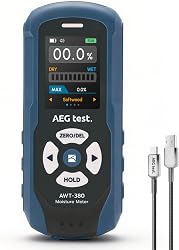
If you hate buying coin cells and want a moisture meter that charges off the same USB-C cable as your phone, the AEGTEST AWT-380 makes a strong case. It reads in about a second, and the color screen is genuinely nice to look at in a dim basement or a shadowy crawlspace. Battery status, alarm indicators, moisture number, all right there without squinting.
I like the pinless sensing for wall and floor sweeps. No holes, no patching, and you can drag it across drywall while hunting for the wet edge of a leak. The adjustable alarm earns its keep here too. Set your threshold, mute the beep if it’s driving you nuts, and let the visual alert flag the trouble spots.
Here’s the honest part. This thing runs hot on the numbers. For a rough damp-or-dry check that’s fine, but I wouldn’t trust it for anything precise. Compared to the Klein ET140, which gives you dedicated hardwood and softwood calibration you can lean on, the AWT-380 tends to read high and gets jumpy on marginally damp material. It’s flagging problems that may not be problems.
So treat it as a leak-hunter and drying-progress monitor, not a woodworking instrument. For quick damp-spot checks around the house with no battery hassle, it’s solid value. If you need pin accuracy and a wide wood-species library on a tight budget, keep reading.
- USB-C rechargeable, no coin cells
- One-second pinless readings
- Clear color screen, easy alarms
- Reads high, poor for wood accuracy
6. Mecurate Digital Moisture Meter

If you burn wood or work with a rotating cast of species, this Mecurate is where the budget category gets interesting. The headline for me is the calibration range. Between two modes and eight scales, it covers 100+ wood and material types, and that matters more than it sounds. Oak, pine, maple, walnut, and whatever mystery hardwood ended up in your firewood pile all read differently, and dialing in the right scale gets you closer to the truth than a one-size meter ever will.
The three colored LEDs give you a quick low/medium/high glance, and the backlit screen with a Hold function saves you when you’re crouched over a woodpile in bad light. Batteries come in the box, and the bonus ambient temperature readout in C or F is a nice touch for shop conditions.
Compared to the General Tools MMD4E, the Mecurate throws in far broader species calibration and that temperature sensor. The MMD4E feels more solid in hand, though, and ships with a proper calibration cap. The buttons here feel cheap, and I’d pull the batteries before long storage.
That wraps my roundup. Match the meter to how you actually work, and any of these will serve you well.
- 100+ wood-type calibration scales
- Backlit screen, Hold function
- Cheap-feeling buttons
Which Moisture Meter Should You Get? Quick Recommendations
You’ve seen the contenders. Now let me match them to what you’re actually trying to do. Find your situation below and grab the tool that fits.
You found a water stain and need to know how far it spread
The clock is ticking and you don’t want to poke a hundred holes in your drywall chasing a leak. Reach for the Klein Tools ET140. Its pinless scan reaches about 3/4 inch down, so you can sweep the wall and map the wet zone in a few minutes without leaving a mark. Once the wall is dry and patched, seal the stain before repainting or it will ghost straight through — that step is covered in my stain-blocking primer guide.
Weekend woodworker building from mixed lumber
If your shop holds cherry one week and poplar the next, you need a meter that speaks all those languages. The Mecurate Digital Moisture Meter carries over 100 species scales, so your readings actually mean something no matter what’s on the bench, and it won’t drain your project fund. Dry stock also machines cleaner, which matters most on profiles cut with a router table.
Stacking firewood and waiting for it to season
Green wood is a waste of a good fire. The General Tools MMD4E gives you honest pin-type readings for cheap, and the audible tones let you jab your way through a whole cord fast to hear what’s ready to burn.
Inspector or contractor whose reports might get challenged
When your numbers could land in a dispute, you want a name that carries weight. The Protimeter Mini comes with a calibration check device and three decades of pro credibility behind it, so nobody can wave off your readings as guesswork.
Installing hardwood floors with a documented moisture spec
Flooring warranties don’t care about ballpark. They want a number, and they want it traceable. The Wagner Orion 910 delivers that with its IntelliSense temperature compensation and on-demand calibrator, giving you readings you can put in writing and stand behind.
Tight budget, just need a quick leak-or-no-leak answer
Sometimes you only need to know if the wall is wet, full stop. The AEGTEST AWT-380 is your grab-and-go pick, with USB-C charging, a color screen, and custom alarms. Just remember its readings run high, so lean on it for a yes or no, not for precision work.