

Leather can be dramatic. One glue makes a clean, flexible repair that just disappears into the project. The next turns a wallet or a boot into a stiff little crime scene. I learned that the hard way. Sticky fingers, a few words I won’t repeat, the usual.
What I want from the best leather glue is simple: grab hard, stay flexible, and survive getting bent, yanked, and hauled around all day. So that’s what I threw at these. Loose soles, peeling straps, split seams, a couple of sad upholstery jobs.
Some of them surprised me. A few felt like old shop regulars from the first squeeze; others looked great right up until the leather started moving. The reviews below sort the keepers from the ones that quit early.
Best Leather Glues in 2026
| Image | Model | |
|---|---|---|
 | Best Overall Barge Quart CementEditor's Choice  Check Price | Check Price |
 | Best Water-Based Fiebing's Leathercraft CementCheck Price | Check Price |
 | Best Low-Odor Cement Renia Aquilim 315Check Price | Check Price |
 | Best for Clean Indoor Repairs Tandy Leather WeldCheck Price | Check Price |
 | Best for Suede & Soft Leather Aleene's Leather GlueCheck Price | Check Price |
 | Best for Quick & Precision Repairs Gorilla Micro PreciseCheck Price | Check Price |
 | Best for Shoe & Sole Repair Shoe Goo ClearCheck Price | Check Price |
1. Barge All Purpose Cement Quart

When I picture leather glue that earns a spot on a real workbench, Barge is the first name in my head. The quart can handles leather repair, footwear work, rubber, vinyl, and the kind of general shop fixes where weaker glues quit early. If a whole quart feels like overkill, the same cement comes in a little 2 oz tube that tucks right into a repair kit.
Bond strength is the whole point. Coat both surfaces, wait until the cement is ready, press firmly — and you get the grip I want on soles, leather layers, liners, welts, repair seams. For hand-stitching, that matters. The pieces have to stay put instead of wandering off like a tape measure with a grudge.
It’s not gentle, though. The smell is a lot, so I crack a window or work outside, no exceptions. The lid brush is fine for rough jobs, but for cleaner leather I grab a separate throwaway brush. And cleanup fights back without the right solvent. This is a shop glue, not a kitchen-table craft glue — know that going in.
Pros:
- Excellent choice for long-lasting leather bonds
- Works well on footwear repairs and leather-to-rubber jobs
- Useful well beyond leather — rubber, vinyl, wood, metal, and plenty of other shop materials
- Quart size makes sense for frequent repair or leatherwork projects
Cons:
- Strong odor means ventilation is not optional
- Built-in brush can be messy for detailed leather work
2. Fiebing’s Leathercraft Cement Flexible 4 oz Glue

Fiebing’s Leathercraft Cement is the bottle I keep within reach for small repairs, craft work, and the oddball fixes that don’t deserve a full sewing setup. It’s a 4 oz bottle, water-based, so it’s easier to live with than the harsh contact cements. Belt loops, straps, sheath work, boot repairs — leather to leather — it holds without turning the piece into a plank.
The grip-versus-flex balance is what sells me. Once it sets, the bond takes bending and everyday movement, which is exactly what shoes, jackets, purses, wallets, gloves, and furniture need. I still prep the surface first, especially smooth leather. Glue isn’t magic, much as I keep hoping. Scuff the contact area, apply it with some care, and the difference is real.
One thing I watch: the bottle. I’ve had one show up dried out, and a dead bottle is, well, dead — nothing you can do with it. When it arrives good, this is one of my go-to picks for a clean, dependable bond without dragging out needles, thread, and an apology to my thumbs.
Pros:
- Good choice for leather repairs that need to stay flexible.
- Works on a wide range of leather goods, including shoes, bags, jackets, gloves, and furniture.
- Water-based formula is easier to handle than more aggressive shop adhesives.
- 4 oz size is handy for repeated small projects and repairs.
Cons:
- A dried-out bottle is possible, so I inspect it right away.
- Smooth leather needs proper surface prep for the best hold.
3. Renia Aquilim 315 Low-Odor Cement

Renia Aquilim 315 is what I reach for when I want leather glue without fogging the shop into a chemical haze. If the Barge fumes up top made you wince, this is the antidote — a water-based, contact-style cement in an 8 fl oz bottle with a much friendlier smell than the old solvent cans I grew up on.
Don’t mistake gentle for weak. It’s a serious leathercraft glue. Works on veg-tan and oil-tan, sets fast, and still leaves me a sliver of working time before it fully grabs. Thin even coat, short open time, firm press — that’s the whole routine. Globbing it on never made anything stronger; it just makes a bigger mess with more confidence.
The flex is the other thing I like, and it matters on anything that bends or gets handled hard. I’ve used it for leather layering, hide projects, hat work, even some EVA foam, so it stretches past one narrow job. My gripe is the bottle: I’ve fought with the lid and seal, so I store it upright, wipe the rim, and close it carefully every single time.
Pros:
- Low-smell formula is much nicer for indoor leatherwork.
- Works on both veg-tan and oil-tan leather.
- Fast setup with a strong, flexible bond.
- Useful for layered leather projects and some foam work.
Cons:
- 8 oz may go quickly on larger builds.
- Bottle sealing and cleanup can be a little fussy.
4. Tandy Eco-Flo Leather Weld Clear Adhesive

Tandy Eco-Flo Leather Weld is my pick for bench-top repairs where I want control, not a chemical cloud. It’s water-based, 4 fl oz, in a squeeze bottle, and that fine tip earns its keep on seams, edges, patches, craft leather, and small fixes on shoes or jackets. I grab it when neatness counts — it dries transparent instead of leaving an obvious glue line.
Like the Renia above, it leans on water-based, low-odor chemistry, only the squeeze tip gives me finer aim. The hold-and-flex balance is good too. Leather moves and folds and gets tugged, and a rigid glue just sets up a future crack. This one stays bendable, which suits wallets, belts, footwear, bags, and layered work. My shop has enough mystery smells already; I’m glad not to add another.
I won’t oversell it. If the repair is edge-to-edge with no real overlap, there’s not enough surface for the bond to grab. Give it some mating area, clamp or weight it, and it does its job. For visible indoor leatherwork, it’s one of the cleaner, friendlier options here.
Pros:
- Clear finish helps keep visible repairs looking tidy.
- Water-based formula is easier to live with indoors than harsher solvent glues.
- Squeeze bottle gives good control on small seams, edges, and patches.
- Flexible bond suits leather items that bend during normal use.
Cons:
- Not ideal for repairs with very little contact area or overlap.
- Best suited to indoor projects rather than heavy outdoor exposure.
5. Aleene’s Leather & Suede Craft Glue

I treat Aleene’s Leather & Suede Glue as a bench-drawer adhesive for small jobs, not a miracle in a bottle. Craft work, trim, small shoe touch-ups, purse details, decorative add-ons — that’s its lane. It sets quick enough that I’m not babysitting two pieces all afternoon, and the dried joint keeps some flex instead of going board-stiff.
What I like most is how it behaves around soft stuff. On suede and thin leather, a sloppy glue can bleed, darken the surface, or leave the project looking like it lost a fight with a syrup bottle. This one’s built for cleaner work, which matters when the repair shows. I still test it on a hidden spot first, especially on nicer hide. Just good shop manners.
Where I draw the line is heavy wear. Rebuilding a work-boot sole, fixing a stressed handbag seam, bonding a spot that gets yanked daily — for that I’d climb back up to the Barge or the Shoe Goo below. For light repair and craft use, though, this little 2 fl oz bottle is easy to keep around and handy when a project just needs a neat bond.
Pros:
- Good choice for leather and suede crafts, embellishments, and minor fixes
- Sets quickly, which helps when lining up small pieces
- Finished bond remains flexible enough for many soft goods
- Clear finish helps keep visible repairs looking cleaner
Cons:
- Not the glue I would choose for high-stress or structural leather repairs
- Application needs a careful hand, especially if the surface may be dyed later
6. Gorilla Micro Precise Super Glue Gel

I like this Gorilla gel for the repairs where a big smear of adhesive would be its own crime scene. The dispenser is the star — it lays down a tiny amount without flooding the work, which is exactly what I need on narrow edges, little tabs, decorative bits, or a small spot that has to stay clean.
The gel body helps too; it’s far easier to steer than a watery super glue. It grabs fast — a few seconds to maybe half a minute — so I don’t treat it like a slow cement I can fuss with and reposition forever. Dry-fit, apply, press. Done. For tiny fixes that speed is a gift. For anything that flexes, though — straps, wallets, soles — I’d skip the super glue and go back to the Fiebing’s or the Shoe Goo.
The two-pack suits my shop, since small super glue tubes are grab-and-go and vanish into drawers. Each tube is compact at 5.5g, so it’s not the bulk option. The cap design is a quiet win, too — clogged tips are the kind of small annoyance that makes a grown adult mutter at a junk drawer.
Pros:
- Excellent control for very small glue spots
- Gel consistency helps reduce messy spreading
- Sets quickly when the pieces are ready to join
- Comes as a two-pack, which is handy for the shop or junk drawer
Cons:
- Small tube size is not ideal for bigger leather projects
- Fast grab leaves little time for adjusting the fit
7. SOF SOLE Original Shoe Goo Clear
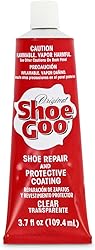
When I’m picking leather glue for shoes, I want some give in it. Hard, brittle glue can look perfect on day one and crack the first time the sole flexes. SOF SOLE Original Shoe Goo goes straight at that problem. It’s a 3.7 fl oz clear tube built for footwear repairs where leather meets rubber, vinyl, canvas, or the usual shoe materials.
This is what I reach for when a boot toe starts gaping, a heel edge needs sealing, or a favorite pair has a sole trying to retire early. The cured repair turns tough and rubbery, which is the whole game on footwear — every step twists that joint. It shrugs off wet conditions too, so it makes sense for boots, waders, galoshes, and beat-up work shoes that see more than clean carpet. The Barge up top is still my all-rounder for general leatherwork, but for a sole that has to keep flexing, this is the one I trust.
The catch: it’s no dainty craft glue. Get heavy-handed and it strings and smears, and the smell is strong enough that I’d rather run it in the garage with the door up than at the kitchen table. I give it the full drying window before wearing the shoes, and for thick sole repairs I just wait. Tape, weight, or clamps keep everything tight while it sets. Not fancy. Very much a workshop fix.
Pros:
- Good match for leather footwear repairs, especially soles, heels, and small damaged spots.
- Flexible cured bond suits shoes better than stiff general-purpose glues.
- Clear formula is useful when I do not want the repair to stand out too much.
- Works across common shoe materials including leather, rubber, vinyl, and canvas.
Cons:
- Strong odor means ventilation is not optional in my book.
- Can get messy, and cleanup is much easier before it dries.
Types of Leather Glue (and When to Reach for Each)
Here’s the thing nobody warns you about when you start gluing leather: not all “leather glue” is the same animal. There are a few categories, and the wrong pick means your project lets go in a week — or worse, bonds rock-hard and cracks the second the leather flexes. Ask me how I know. I glued a watch strap with the wrong stuff once and watched it snap off mid-meeting. Real smooth.
Quick rundown so you skip my mistakes:
- Contact cement — the workhorse for most leatherwork. Coat both sides, let them go tacky, press. Instant grip, strong as anything. Soles, belts, bag panels. The Barge and Renia up top live here.
- White/PVA-style leathercraft glue — flexible, dries clear, sands nicely. Great for edges and anything that needs to bend without cracking. The Fiebing’s and Tandy are my go-tos.
- Cyanoacrylate (super glue) — fast, but brittle. Fine for tiny repairs and tacking spots down, lousy for anything that flexes. That’s the Gorilla gel’s lane.
- Rubber cement — temporary, repositionable holds. Don’t trust it with anything load-bearing.
If your project flexes — straps, wallets, shoes — skip the cyanoacrylate and grab a flexible contact cement or a quality leathercraft glue instead. That one rule saves a world of grief.
Flexibility vs. Strength — The Eternal Tug-of-War
This is where most folks trip. A super-strong bond sounds great until you remember leather is built to move. Dries hard and stiff? Every bend dumps stress onto that rigid seam, and sooner or later it cracks like old caulk. Go too far the other way — a glue that stays gummy — and it may not hold under shear when you, say, load up a heavy bag.
Peel resistance is the number that matters here — basically how well two glued pieces resist being pulled apart at an angle. There’s even a test for it, ASTM D903, which is why some glues brag about “peel strength” on the label. For leather-to-leather bonds that have to survive real flexing, chase high peel strength over raw tensile numbers.
Viscosity and Application — Thin, Thick, or Gel?
Viscosity is just how runny the glue is, and it matters more than you’d guess. Thin glues soak into porous, raw hide and tack up fast. Thicker gels stay put on vertical surfaces and slick, finished leather, where a runny glue would slide right off onto your bench — and your jeans, and the cat.
Adhesive makers test this under ASTM D2556, which measures apparent viscosity. For your purposes, just match the glue to the job:
- Thin/liquid — porous, rough leather and fast-tack jobs.
- Medium — general all-purpose work, the safe default.
- Gel/paste — vertical surfaces, finished leather, gap-filling. The Gorilla gel is the obvious example.
Test on a hidden scrap first — finished leather with a sealed surface can reject thin glue completely, and you won’t find out until it peels.
Safety — Ventilation, VOCs, and Not Killing Brain Cells
I’ll be straight: solvent-based contact cements are the strongest option for a lot of leatherwork, but they reek. That smell is volatile organic compounds, and they aren’t doing your lungs any favors. The EPA flags VOCs from glues and adhesives as a real hit to indoor air quality — worse in a shut-up garage in January when you don’t want to crack the door.
Using the smelly stuff? Take it seriously. OSHA’s flammable-liquids standard leans hard on ventilation and keeping ignition sources away — and a lot of these cements are flammable, so kill any pilot lights or sparks nearby. Work by an open window or with a fan pulling fumes away, and never run solvent cement near an open flame or a water-heater pilot. If you’re using cyanoacrylates, the NIOSH chemical guide for methyl cyanoacrylate is worth a skim too, since super glue can sting eyes and airways fast.
Want to dodge most of the headache — literally? Low-VOC and water-based leather glues have come a long way. They’re not always as nuclear as the old solvent cans, but for most hobby and repair work they’re plenty, and you walk away clear-headed. For indoor work or anywhere with poor airflow, go water-based and low-VOC — the Renia and Tandy up top are good examples — and save the solvent cement for outdoors or a well-ventilated bench.
Drying Time and Clamping — Patience Pays
Different glues run on different clocks. Contact cement gives that satisfying instant grab — but only if you let it flash off to the right tackiness first. Rush it and you get a weak, gummy mess. Water-based and PVA-style glues want clamping or weight and real cure time, sometimes overnight, before you stress the joint.
My rule: whatever the label claims for cure time, give it a little extra before you put the piece to work. Don’t confuse “dry to the touch” with “fully cured” — a bond that feels set in an hour might not hit full strength for a day. I wrecked a perfectly good belt by wearing it the same afternoon I glued it. Don’t ask how I know.
Edge Cases — Bonding Leather to Other Stuff
Leather-to-leather is easy mode. It gets interesting when you stick leather to rubber, metal, fabric, or foam — resoling a shoe, lining a bag, that sort of thing. For mixed jobs, contact cement is usually your friend because it’s built to bridge dissimilar materials. The Barge handles this all day, and for shoe soles in particular the Shoe Goo is made for exactly that leather-meets-rubber seam.
For nonporous surfaces — metal, glossy plastic — prep is everything. Rough it up with a bit of sandpaper, wipe it clean, give the glue something to bite. On smooth or nonporous substrates, scuff and degrease before gluing — skip it and the bond is doomed no matter how good the adhesive.
Short version, if you just want the answer: I reach for the Barge when strength is everything, the Fiebing’s or Tandy when the repair has to bend, the Renia when I’m stuck working indoors, and the Shoe Goo when a sole’s coming apart. Match the glue to the way the leather actually moves, and most of these fixes outlast the thing you’re fixing.