

You don’t need to drop $500 or more to make clean miter cuts. But grab the wrong cheap saw and you’ll fight wobbly fences, angles that drift mid-cut, and a growing pile of ruined trim. I’ve seen it happen. A guy buys a bargain saw, blames himself for the crooked joints, and never realizes the tool was the problem all along.
Here’s the thing. A low price doesn’t automatically mean junk, and a shiny display model doesn’t automatically mean quality. Some of these saws hold their angles like a champ. Others feel solid in the store and fall apart the first time you lean on them. My goal is to help you find the best budget miter saw that cuts straight today and still cuts straight two years from now.
So I put a handful of them through real work. Fence squareness, blade slop, how they handle a stubborn piece of oak. Stick around and I’ll show you which ones earned their spot on the bench, and which ones are just cheap for a reason.
Best Budget Miter Saws in 2026
| Image | Model | |
|---|---|---|
 | Best Overall Metabo HPT C10FCG2Editor's Choice  Check Price | Check Price |
 | Best for Crown Molding SKIL MS6305-00Check Price | Check Price |
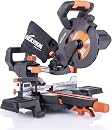 | Best for Mixed Materials Evolution R185SMS+Check Price | Check Price |
 | Best for Tight Spaces WEN MM0713Check Price | Check Price |
 | Best for ONE+ Owners RYOBI ONE+ 18V Sliding Miter SawCheck Price | Check Price |
Worth planning before the saw arrives: none of these come with a way to hold an eight-foot board level with the table, and cutting long trim off a wobbly surface undoes whatever accuracy you paid for. A pair from my saw horses comparison is the cheapest fix for that.
What to Look for in a Budget Miter Saw
A budget miter saw doesn’t have to feel like a compromise every time you pull the trigger. The trick is knowing which corners the manufacturer cut on purpose and which ones will haunt you. Here’s what I check before I hand over my money.
Motor Power and RPM
Almost every corded miter saw worth buying runs a 15-amp motor. That’s the ceiling for a standard household circuit, and it’s the sweet spot for budget saws because it gives you enough torque to power through the material most weekend projects throw at you without tripping a breaker. Anything smaller and you’ll feel the blade bog down the second you hit a knot.
RPM tells you how fast the blade spins, and it matters more than most spec sheets admit. Most saws in this class land between 4,500 and 5,000 RPM. Higher RPM gives you cleaner cuts in softwood like pine and framing lumber because the blade slices instead of tearing. In dense hardwood such as oak or maple, that same speed can burn the wood if you feed too fast. Slow your feed rate in hardwood and let the blade do the work rather than shoving the material through.
Single Bevel vs. Dual Bevel
A single bevel saw tilts one direction, usually left. To cut a matching bevel on the opposite end of a board, you flip the workpiece over. It’s a small hassle that adds up fast when you’re running crown molding or a room’s worth of baseboard.
Dual bevel tilts both directions, so you cut both angles without flipping anything. The SKIL MS6305-00 brings dual bevel to a price where most saws stick with single, and it does it without feeling flimsy. That’s the trade-off to watch: some cheap dual bevel saws sacrifice head rigidity to hit the feature, and a wobbly head means inconsistent angles.
- Pick single bevel if you cut mostly straight crosscuts and simple angles.
- Pick dual bevel if you run trim, crown, or repetitive angled work and value speed over flipping boards.
Sliding vs. Fixed Head
A fixed head saw only chops straight down, which caps how wide a board you can cut. A sliding head rides on rails so the blade travels forward and back, and that changes everything. A sliding 7¼-inch saw like the RYOBI ONE+ cordless can match the crosscut capacity of a fixed 10-inch saw, using a smaller and cheaper blade to do it.
The catch is footprint. Traditional slides need clearance behind the saw for the rails to travel, so you can’t shove the unit against a wall. The WEN MM0713 solves this with a dual-rail design that lets it sit flush to a wall, which is a real win in a cramped garage. If bench space is tight, prioritize a wall-hugging slide mechanism over raw capacity numbers.
Slides also introduce a wear point. Cheap rails develop play over time, and play shows up as a slightly off-square cut. Check that the head glides smoothly with no side-to-side wiggle before you commit.
Cut Alignment Systems
Budget saws use one of three ways to show you where the blade will land, and they are not created equal.
- Laser lines project a red beam onto the wood. They drift out of calibration and wash out in bright shop light.
- LED shadow lines light the actual blade so it casts a real shadow on your cut line.
- Shadow-cast systems work the same way, showing the true blade edge with no beam to align.
Shadow systems win because they can’t fall out of calibration. The shadow is the blade, so what you see is exactly where the teeth cut. The Metabo HPT C10FCG2 uses its Xact Cut shadow line, and the SKIL MS6305-00 does the same with its LED Shadow Line. On a budget saw, calibration-free alignment matters more than on a premium saw because cheap laser mounts drift faster and rarely stay true after a few months of use.
Build Quality Red Flags
This is where budget saws separate the keepers from the returns. A saw can spec well on paper and still frustrate you daily if the build is soft. Run your hands over it and check these before you buy.
- Fence rigidity: push on the fence. If it flexes, your cuts won’t stay square.
- Lock knobs: metal threads hold up, plastic ones strip after enough torque.
- Bevel detents: they should click into place with a firm, positive stop, not a mushy approximation.
- Cord gauge: a thin cord chokes the motor and heats up on long sessions.
The bevel detent feel tells you a lot about the whole saw. A crisp stop at 45 and 90 degrees means the internals are machined with care. A vague, floaty detent means you’ll fight the saw to hit repeatable angles. Metabo HPT’s Japanese engineering shows here, and it backs the saw with a 5-year warranty that outlasts most of the segment. The same test applies to the other half of a trim setup: a saw that holds 45° is wasted if the joint is then closed with the wrong adhesive, and I sorted those in my wood glue for miters roundup.
Corded vs. Cordless
Corded saws give you more machine per dollar. You skip the cost of batteries and a charger, and you never wait for a recharge mid-project. For most weekend work in a fixed shop, corded is the smarter spend.
Cordless earns its place when you already own the batteries. If you’re deep in the RYOBI ONE+ ecosystem, their cordless sliding saw runs on packs you already have, and the freedom to cut on a deck or a jobsite with no outlet nearby is genuine. Buy cordless only when you own the battery platform already, because starting from scratch on batteries alone can cost more than the saw.
Dust Collection Reality
Let me be honest. The dust bag that comes with your budget saw is mediocre, and no marketing copy will change that. These bags catch maybe a third of the fine dust and let the rest coat your bench, your lungs, and everything within a few feet.
The real criterion is shop-vac compatibility. Every saw here has a dust port, and the question is whether it fits a standard vacuum hose or a cheap adapter. Hook a shop vac to that port and collection jumps dramatically. Toss the bag in a drawer, connect a vac, and you’ll cut cleaner from day one.
1. Metabo HPT C10FCG2

The first thing I check on any budget miter saw is whether it arrives square, because most don’t. Pull the Metabo HPT C10FCG2 out of the box, run a framing square against the fence and blade, and you’ll likely find it dead-on with nothing to fiddle. That saved me the usual twenty minutes of loosening bolts and tapping a stop into place before I could trust a single cut.
I put it through the test I care about for trim and fencing: repeat 45s on pine and a few crosscuts on oak. The 15-amp motor spins to 5,000 RPM and the 40-tooth blade came out clean, no fuzzy edges or blowout on the back of the board. For baseboard and casing, that matters. A ragged miter means caulk and excuses, and I got neither here.
The Xact Cut shadow line is the piece that surprised me at this price. Instead of a laser you calibrate and re-calibrate, it casts an actual shadow of the blade onto your pencil mark. Line them up, drop the saw, done. Compare that to the SKIL MS6305, which uses an LED shadow line too and even adds dual bevel, but the SKIL’s build feels plasticky next to this one, and its fence flexes in a way the Metabo’s doesn’t. The Japanese-engineered feel and a 5-year warranty tip the reliability column hard in Metabo’s favor.
It’s not perfect. Single bevel means you’ll flip wider boards to finish a compound cut, and it labors on long, thick stock, so heavy framing isn’t its lane. The dust bag is more of a gesture than a solution. But for a weekend crew running trim and fence pickets, this saw stays accurate without asking anything of you.
If flipping boards annoys you and tilting both directions sounds worth some compromises, the SKIL MS6305 brings dual bevel to the table, though it trades away some solidity to get there.
- Square right out of the box
- Shadow line beats laser guides
- Clean cuts on pine and oak
- Light at 24 lbs, 5-year warranty
- Single bevel means flipping wide boards
- Weak dust collection
2. SKIL MS6305-00

On paper, this SKIL reads like the overachiever of the budget aisle. Dual bevel, an LED shadow line instead of a laser, and a work clamp tossed in the box. That’s a spec sheet that usually costs a lot more, so I went in half expecting the reality to fall short of the brochure.
Some of it delivers. The LED Shadow Line is the standout, and it beats a laser for repeat cuts. Instead of lining up a red dot, you watch the blade’s shadow fall exactly where the teeth will land. No calibration dance, no guessing. In my shop under decent light it made trim work quick and clean. Drag it into bright sun and the shadow washes out to nothing, so this is an indoor tool at heart.
The 15-amp motor spins up to 4,800 RPM and never bogged down on pressure-treated 2×8, and the 2×12 crosscut capacity is genuinely useful for a saw this light. Dual bevel earns its keep too. Tilting left and right without flipping the board saves real time on crown and baseboard.
Now the honest part. It feels plasticky. The fence has some flex, and the dual bevel mechanism trades rigidity for that convenience. The lock screws can wobble loose, and the travel-limit screw likes to drift under vibration. Set against the Metabo HPT C10FCG2, that saw feels more solid in hand but only bevels one direction. So it’s a real trade: more function here, a firmer build there.
My take? If you work indoors and don’t mind snugging a few screws between sessions, the feature spread is worth the fuss. Just know the extras came at the cost of a little stiffness.
Both saws so far cut wood and nothing else. But if your list mixes aluminum angle or steel conduit in with the lumber, keep reading.
- LED shadow beats laser guides
- Dual bevel saves flipping boards
- Strong motor, 2×12 capacity
- Plasticky feel, flexy fence
- Screws drift, need recalibration
3. Evolution R185SMS+
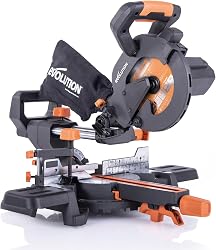
Picture a Saturday where you’re notching steel angle iron for a shelf bracket, then trimming aluminum trim, then cutting a length of 2×4 with a stray nail buried in it. Normally that’s a hacksaw, an angle grinder, and a miter saw all fighting for bench space. The Evolution R185SMS+ does all three with one TCT blade, and that’s the whole reason it earns a spot here.
The multi-material trick is real. Mild steel cuts with barely a spark, no shower of orange grit peppering your forearms, and the edge comes off clean enough that I skipped the deburring on aluminum. Copper, plastic, wood with hidden fasteners, same blade the whole time. For a garage tinkerer who cuts three materials in an afternoon, that saves both money and the hassle of swapping tools.
The ball-bearing slide runs smooth, the laser guide lands close, and I get honest results across the 0 to 45 degree bevel and the 50 degree miter each way. It’s light too, with a rear handle that makes hauling it out to the shed painless.
Where it shows its budget roots: the build leans toward finish work, not rough framing. The included 20-tooth blade cuts fine but I’d swap in something higher-count for cleaner wood edges. The two-prong plug and thin cord don’t inspire confidence for marathon sessions, and the dust bag only handles wood. Next to a single-material saw like the WEN, this one trades polish for range.
Speaking of the WEN, if your headache is fitting a saw into a tight shop rather than cutting mixed metals, it took a completely different route worth a look.
- Cuts steel, aluminum, wood, plastic
- Minimal sparks and burrs
- Light-duty build, finish work only
4. WEN MM0713

If you’ve ever tried to squeeze a full-size sliding saw into a garage corner, you know the problem. The rails hang off the back a foot or more, so the whole thing has to live in the middle of your bench. WEN’s MM0713 solves that with a dual-rail slide that lets the saw sit flush against the wall. In a tight shop, that reclaimed real estate matters.
Capacity surprised me. This is a 7.25-inch saw, but it crosscuts boards up to 11.5 inches wide and 2.5 inches thick, which covers baseboard, casing, and most bathroom reno trim without complaint. The LED shadow line lands where I expect it to and reads better than a laser for lining up cuts. Compared to the Evolution R185SMS+ with its traditional slides, you trade a hair of rigidity for the wall-hugging footprint. For finish work, that’s a fair swap.
The gripes are real. The depth stop knob won’t stay put and needs resetting mid-session, the lock knobs are plastic, and dust collection is more suggestion than function. Left-only bevel means flipping boards too. Still, for a small-shop trim setup, it earns its keep.
One catch worth flagging: it needs an outlet, same as everything so far. If dragging cords up a stairwell has worn thin, the next pick cuts that cord entirely.
- Flush-to-wall space saver
- 11.5-inch crosscut capacity
- Accurate LED shadow line
- Depth stop knob loosens
5. RYOBI ONE+ 18V Sliding Miter Saw

Let’s do the math up front, because it matters here. The sticker on this RYOBI looks budget-friendly, but the battery and charger ship separately. So the real question is what you’ll pay once the saw’s ready to cut. If you already own a shelf full of ONE+ batteries, that number stays low and this thing makes a lot of sense. If you’re starting from zero, you’re buying a saw plus a battery plus a charger, and the value picture shifts fast. I’d only call this a true budget pick for folks already deep in the Ryobi camp.
Out in the field it earns its keep. Up to 800 cuts per charge means I can trim out a whole room without hunting for an outlet, which is the entire point. The 2×10 crosscut capacity surprised me for a 7-1/4 inch cordless saw. It swallows most baseboard and casing without complaint. It’s light too, with real carry handles, so hauling it up a flight of stairs doesn’t ruin your afternoon.
Compared to the corded WEN, which folds flush against a wall and cuts wide, you’re trading that upfront savings for cord-free freedom. One saves outlets, the other saves setup. Pick your poison.
Two honest gripes. The stock 40-tooth blade tears up fine trim, so swap it before your first finish job. And it’s single bevel left only, so wide compound cuts mean flipping stock. A big 9Ah battery also makes it feel top-heavy.
That wraps our budget lineup. Match the saw to your work, respect its limits, and any of these will earn their spot in the garage.
- Up to 800 cuts per charge
- Strong 2×10 crosscut capacity
- Ties into ONE+ ecosystem
- Battery and charger cost extra
Which Budget Miter Saw Should You Actually Get?
You’ve seen the contenders. Now let me save you an afternoon of second-guessing and match a saw to the way you actually work.
Your first miter saw, and you just want it to work
You don’t want to spend your first weekend calibrating a tool with a set of feeler gauges. You want to plug it in and make a clean cut. Get the Metabo HPT C10FCG2. It shows up dead-on, lays down crisp cuts right away, and the 5-year warranty means you can learn without worrying you’ll destroy something expensive.
Crown molding and angled trim in both directions
If your project list leans toward baseboards, casing, and crown, flipping heavy boards to catch the opposite angle gets old fast. The SKIL MS6305-00 bevels both ways, so you tilt the head instead of wrestling the wood. The included clamp keeps your hands clear while you’re still getting comfortable with compound cuts. Trim also has to be fastened once it is cut, and for that I use the picks from my cordless brad nailer guide.
A mix of metal conduit, aluminum, and lumber
Some jobs don’t stay in the wood aisle. When you’re cutting conduit one minute and framing lumber the next, the Evolution R185SMS+ handles all of it on a single blade with barely a spark. It quietly replaces a separate metal chop saw and the storage space that thing would eat.
A tiny garage where every inch counts
Most sliding saws demand a chunk of clearance behind them for the rails, which is a problem when your bench is against the wall. The WEN MM0713 uses flush-to-wall rails, so you can push it back and still get the full slide. Small footprint, full 11.5-inch capacity.
You already own Ryobi ONE+ batteries
If you’ve got a drawer of 18V packs from your drill and blower, half the cost of going cordless is already paid for. Grab the RYOBI ONE+ Sliding Compound Miter Saw as a bare tool and skip the extension cord dance. Perfect for trim work where the nearest outlet is three rooms away.
The tightest budget possible
When the money is truly limited and you still want real capability, the Evolution R185SMS+ wins again. Sliding compound cuts plus cutting metal and wood on one blade, at this price floor, is a combination nothing else touches. It’s the most saw for the least outlay, plain and simple.
Still torn? Buy the one that fits how you’ll actually use it, not the one with the longest spec sheet. Any of these will outlast the project that made you buy it.