

You finally decide to install new baseboards on a Saturday morning, then spend 45 minutes untangling the compressor hose before driving a single nail. By lunch, the trim is still leaning against the wall and the compressor has scared the dog twice.
The best cordless brad nailer should feel boring in the best way: pick it up, set the depth, sink clean nails, move on. No hose. No oil. No little dance around a pancake compressor in the hallway.
Some cordless nailers punch like rentals at the end of a long day. A few drive like the air tools I grew up using. Those are the ones worth talking about, and below I break down how to choose one before walking through the seven I put through real trim work.
Best Cordless Brad Nailers in 2026
| Image | Model | |
|---|---|---|
 | Best Overall DeWalt DCN680BEditor's Choice  Check Price | Check Price |
 | Best Lightweight & Compact Metabo HPT NT1850DGCheck Price | Check Price |
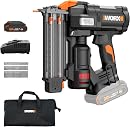 | Best for Hardwoods WORX WX838L.1Check Price | Check Price |
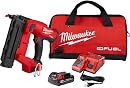 | Best for Pros Milwaukee M18 FUEL 2746-21CTCheck Price | Check Price |
 | Best for Weekend DIY Craftsman V20 CMCN618C1Check Price | Check Price |
 | Best for ONE+ Users Ryobi ONE+ P321Check Price | Check Price |
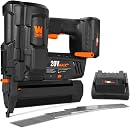 | Best Budget Value WEN 20512Check Price | Check Price |
1. DeWalt DCN680B

Picture hanging a run of casing after dinner, with the compressor still buried behind the lawn chairs and one air hose kink away from ruining your mood. That is where the DeWalt DCN680 makes its case. I can grab a 20V MAX battery, load 18 gauge brads, and get trim fastened without dragging half the garage into the room. For finish carpentry and serious weekend work, that convenience matters more than folks admit.
The part I like most is the consistency. The brushless setup gives this nailer the kind of repeatable drive I expect from a good air nailer, especially on hardwood trim where weaker cordless models start leaving proud heads. The depth control is easy to dial in, and once I find the setting, I do not feel like I am chasing it every few boards. On stain grade work, that saves putty and saves pride.
The nose is a mixed bag, in a useful way. DeWalt’s smaller tip area gives me a better sightline than older cordless designs, so lining up on narrow shoe molding or small returns feels more controlled. Still, the body is not as slim as a pneumatic gun. If I am tucked inside a cabinet face frame or trying to sneak into crown molding corners, I notice the bulk. Cordless freedom comes with some girth. There is your shop wisdom for the day.
Compared with the Milwaukee 2746 21CT, this DeWalt is right in the premium fight. Milwaukee has the sharper firing feel on paper, with instant response and no windup behavior, while the DeWalt leans on steady power and depth control to feel close to air. The DeWalt’s nose helps with placement, but both tools ask you to accept more weight and size than a hose fed brad nailer. I think the choice comes down to battery loyalty as much as anything. If your garage already runs yellow 20V MAX packs, the DCN680 makes a lot of sense.
A couple quirks are worth knowing before you start a full house of baseboard. I make a clean full trigger release between shots, because the reset behavior can punish sloppy rhythm. I also reload before the strip gets too low, since the last few nails are where feeding can get fussy. This DeWalt sets a very high cordless standard, and the next serious rival gets there by using a different driving system entirely.
- Excellent depth consistency
- Strong hardwood performance
- Accurate nose placement
- Great DeWalt ecosystem fit
- Bulkier than air nailers
- Tool only adds cost
2. Metabo HPT NT1850DG

The mechanical spring setup is the reason I like the Metabo HPT NT1850DG for finish work. There is no gas cartridge to buy, no compressor to drag out, and no waiting for the nailer to spool up before it fires. Press, place, shoot. That simple rhythm matters when I am walking a room with base cap or pinning face frames where a slow trigger feel turns into crooked little mistakes.
Compared with the DeWalt DCN680 and its brushless motor approach, this Metabo feels like the simpler long term ownership play. DeWalt brings strong cordless performance, but the spring drive here keeps the system refreshingly straightforward. For a woodworker or finish carpenter who wants repeatable 18 gauge shots without extra consumables, that simplicity earns its keep.
At 5.5 lbs, it is not the featherweight of the cordless brad nailer crowd, but the balance helps. I would still think twice before using it overhead all afternoon on crown or ceiling detail. For casing, cabinet trim, built ins, and shop projects, the weight feels manageable and the lack of hose makes the whole job less fussy.
The included 2.0Ah battery is rated for up to 700 shots, which covers a lot of weekend trim work before lunch gets cold. I also like the fuel gauge, LED light, no mark tip, and tool free depth adjustment. My tip is simple: after switching from short brads to 2 inch nails, test on scrap and reset depth before touching the real piece. Also keep an eye on the magazine, since this nailer can fire empty.
Metabo HPT owns the sensible middle lane here, though the next contender makes a case with less weight and a clever battery sharing setup.
- Instant spring driven firing
- No gas cartridges
- Strong battery runtime
- No dry fire lockout
3. WORX WX838L.1
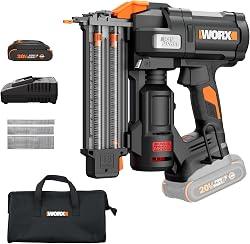
At 4.4 lbs, the WORX WX838L.1 is the lightest cordless brad nailer in this roundup, and that matters more than folks think once baseboard turns into crown, casing, and a few awkward overhead shots. I like a tool that does not make my forearm file a complaint before lunch.
The bigger story is the PowerShare battery setup. If I already had WORX yard or shop tools, this nailer would make a lot of sense because the same battery family can support 20V, 40V, and 80V tools by pairing packs as needed. Compared with the Metabo HPT, which is a sturdier 5.5 lb tool with its own strong battery angle, the WORX feels more weekend friendly and easier to live with during trim work. Compared with WEN, which leans hard into budget value, WORX lands as the lighter, more ecosystem minded pick rather than the cheapest way in.
For finish projects, the specs line up well. It handles 18 gauge brads up to 2 1/8 inches, and the narrow nose helps when I am trying to pin shoe molding tight to a corner without guessing where the nail will land. The three work lights are useful inside cabinets and shadowy closet trim. Sequential fire is the mode I would use for visible work, while contact firing makes sense for longer runs once depth is dialed in.
I would not treat this as a crew truck nailer for daily abuse, and the included bag sounds too small to be much help. Still, for a DIYer building around WORX batteries, this is a smart cordless brad nailer. Next, Milwaukee brings a more premium M18 FUEL feel to the conversation.
- Lightest tool here
- Shared WORX batteries
- Good trim visibility
- Not contractor focused
4. Milwaukee M18 FUEL 2746-21CT

The first thing I care about with a cordless brad nailer is the pause between pulling the trigger and hearing the nail sink. With this Milwaukee M18 FUEL, that pause is basically gone. It has the rhythm I expect from an air nailer, which matters when I am walking a room full of casing or running base and trying not to break stride every three feet.
That instant response is the big reason I see this as a professional trim tool, not just a nice cordless convenience. Some battery nailers make you slow down a hair while the tool gets ready. This one fires when I ask it to, and the depth stays steady across soft trim stock and harder material. I still test on scrap before touching finished work, because I like my mistakes hidden in the cutoff pile, but I would not expect to keep fiddling with the depth wheel all morning.
Against the DeWalt DCN680, this is one of the two serious premium choices. The DeWalt has plenty of pro credibility, but its trigger reset behavior can interrupt a fast cadence if your finger does not fully come off between shots. Milwaukee feels more natural to me for production trim. Kit value also tilts Milwaukee’s way since this package includes a battery, while the DeWalt setup does not. Ergonomically, Milwaukee gets the nod too, since the DeWalt is known for feeling bulkier in tight work.
I like the practical touches. Depth changes and jam access do not send me digging through a toolbox, it has sequential and bump style firing, and it stops you before dry firing into empty air. That last one saves trim, drivers, and my mood.
My honest take: if cordless brad nailing is part of your income, this one earns its premium spot. For a couple bedrooms of baseboard on a Saturday, Craftsman starts to look like a more sensible middle lane.
- Instant shot response
- Consistent depth control
- Battery included in kit
- Comfortable for long trim runs
- Premium pricing
5. Craftsman V20 CMCN618C1

I’ll be blunt: I like this Craftsman most for the homeowner who installs baseboards, hangs a little trim, builds a shelf, then puts the nailer away until the next Saturday project. It does not ask much from you. Load 18 gauge brads, set the depth without tools, and get to work without dragging out a compressor like it owes you money.
The simple setup is the selling point here. Jam clearing is also tool free, which matters when you are crouched beside a door casing and patience is leaving the room. Firing power stays steady across different materials and weather, so for ordinary interior trim work, I would trust it to keep moving.
The catch is angle work. This nailer wants to sit square to the surface, and toenailing is where it can misfire. Compared with the Ryobi P321, both live in the same casual DIY lane, but Craftsman feels more straightforward while Ryobi brings a broader ONE+ battery universe. Ryobi also has its own firing quirks, including needing the trigger held until the nail seats and possible striker jams. If you already own Craftsman V20 tools, this is an easy pick. If your shelf is packed with Ryobi batteries, that ecosystem may pull harder.
- Simple tool free setup
- Good casual trim fit
- V20 battery compatibility
- No reliable toenailing
6. Ryobi ONE+ P321

If I already had Ryobi ONE+ batteries on the shelf, this P321 would make a lot of sense before I went wandering into another battery aisle. A cordless brad nailer is the kind of tool I want ready for baseboards, shoe molding, cabinet trim, and small furniture fixes, and sharing the same 18V packs keeps the whole setup simple. With a 4.0Ah battery, I would expect it to handle an afternoon of trim work without babysitting the charger.
The learning curve is in the trigger. This one wants a steady press until the brad is fully driven. Let off too soon and it can lock up with an error light, which is the sort of thing that makes a five minute casing job feel like a tiny argument. Once I slow down and let the tool finish its cycle, it should behave much better. Think squeeze, hold, then move. Not squeeze and flee.
Compared with the Craftsman CMCN618C1, both aim at the same DIY sweet spot, but their quirks are different. The Craftsman is fussier about being held square and is not the one I would pick for angled nailing. The Ryobi’s bigger caution is striker jamming, which may need a little lubrication to settle down. I like the Ryobi more for someone already deep in the ONE+ system, while a pure budget shopper should keep an eye on what WEN brings to the table next.
- Shares ONE+ batteries
- Good 4.0Ah runtime
- Easy depth tuning
- Trigger timing takes practice
- Striker may need lubrication
7. WEN 20512
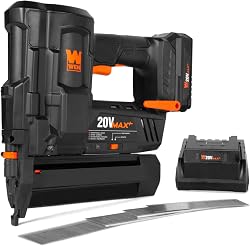
The WEN 20512 surprised me on the price to feature side first. For a budget cordless brad nailer, getting two firing styles, a 100 nail magazine, included starter brads, and a status light that reports more than just battery level feels like a lot of tool for occasional trim work.
Then comes the catch. Jams are the thing I would watch closely here. Some brad nailers make clearing a bad nail a quick flip and pick job. This one can turn into a small bench project because clearing a jam may require tools. If I were using it for baseboard, beadboard, or casing around a couple rooms, I would keep a punch, pliers, and the manual nearby. Annoying? Yep. Deal breaker for light home use? Maybe not, if the price is what got you in the door.
For the good stuff, the cordless setup is exactly what I want for weekend trim. No compressor waking up the house, no hose snagging a freshly painted corner, no dragging gear from room to room. It handles 18 gauge brads from 3/4 inch to 2 inches, which covers the common homeowner list pretty well. The single shot mode is what I would use for visible trim. Contact firing makes more sense for paneling or repetitive shop work, assuming you are comfortable controlling the nose.
Compared with the WORX WX838L.1, both live in the affordable cordless lane and both offer dual firing modes. The WORX gives me stronger long term signals because its drawbacks are less about internal stoppages. The WEN fights back with a smarter light system and very strong value, but its jam clearing is the weak ankle.
My closing thought: for budget conscious homeowners, this is a capable buy if you accept its limits and do not treat it like a jobsite finish gun.
- Strong budget value
- Dual firing modes
- Awkward jam clearing
- Can leave proud nails
How to Pick the Right Cordless Brad Nailer for Your Projects
Driving Mechanism and Firing Speed
The drive system is the heart of a cordless brad nailer. It decides how fast the tool wakes up, how evenly it sinks nails, and whether it feels like a real finish nailer or a sleepy stapler wearing a hard hat. Most cordless 18 gauge brad nailers use one of three setups: brushless motor drive, mechanical spring drive, or air impact drive.
- Brushless motor systems, like the DeWalt DCN680, manage power well and tend to give steady depth without gas cartridges.
- Mechanical spring systems, like the Metabo HPT NT1850DG, store energy in a spring and fire with very little delay.
- Air impact systems, like the WORX WX838L.1, use onboard pressure to drive nails without dragging a compressor around the room.
If you are trimming one room, a slight pause before firing may not ruin your day. If you are installing baseboard through a whole house, that pause gets old fast. For finish work where rhythm matters, pick a nailer that fires without a noticeable ramp up delay. The Milwaukee M18 FUEL feels close to a pneumatic gun here, with instant firing and consistent depth across common trim woods.
Weight and Ergonomics
Most cordless brad nailers land somewhere between 4 and 7 pounds once the battery is on. On paper, that sounds like a small spread. Overhead, while pinning crown molding and trying not to dent the ceiling, two pounds feels like a bowling ball by lunchtime. I care less about the catalog weight and more about where that weight sits in my hand.
A good cordless brad nailer should balance near the grip, not nose dive like a framing hammer tied to a brick. The handle should let your trigger finger sit naturally, and the nose should be easy to see when you are lining up on a casing reveal. I also look for a belt hook that can swap sides, since left handed and right handed work both happen once you are wedged between a ladder and a wall.
- For ceiling trim, lighter tools are easier to control over long stretches.
- For bench work, balance matters more than raw weight.
- For tight corners, a slim nose and clear sight line beat a bulky body every time.
Battery Platform Compatibility
Battery platform matters more than folks like to admit. A cordless brad nailer sold as a bare tool may look like a bargain until you add the battery and charger. If you already own DeWalt, Milwaukee, Ryobi, Craftsman, WORX, or Metabo HPT batteries, staying inside that system can save money and keep your garage from turning into a charger museum.
The Ryobi P321 makes a lot of sense for people already using Ryobi ONE Plus 18V tools. Same idea with the Metabo HPT NT1850DG if you are already invested in MultiVolt. The WORX WX838L.1 also has a useful angle because its PowerShare battery can run across WORX 20V, 40V, and 80V tools when paired properly within that system. The DeWalt platform is the broadest of that group, and the drill is usually what anchors it — see my DEWALT drill comparison.
Before buying, price the tool with the battery and charger you will really need, not just the bare tool sitting in the listing. Also check battery size. A compact pack keeps the nailer lighter and better balanced. A larger pack runs longer, but it can make the tool feel tail heavy during trim work.
Depth Adjustment and Nail Size Range
Tool free depth adjustment is one of those features I refuse to give back. Pine casing, MDF baseboard, oak trim, and cabinet face frames all take nails differently. If I can twist a dial and move on, I stay productive. If I need an Allen key every time the material changes, that key will vanish into the same black hole that eats tape measures.
For brad nail size, I like to see a range from 5/8 inch up to 2 1/8 inches. Short brads work for thin trim, shoe molding, and small craft panels. Longer brads give better hold through baseboard, door casing, and layered trim assemblies. A nailer that stops at shorter lengths limits what it can do around the house.
Match nail length to the job: aim for enough brad to pass through the trim and bite well into the backing, without blasting through the far side. For most interior trim, that usually means the nail needs to penetrate the framing or jamb by about 3/4 inch or more. Brads hold the piece while something else does the real work, which on mitred returns and scarf joints means glue — I compared open times in my wood glue roundup.
Dry Fire Lockout and Jam Clearing
Dry fire lockout stops the tool from firing once the magazine gets too low. I like this feature because an empty shot can leave a mark in finished trim without fastening anything. It also tells you to reload before you spend five minutes wondering why the last three pieces feel loose.
Some budget nailers will keep cycling after the nails are gone. That is not the end of the world, but it does waste time and can scuff softer materials. If you are working on painted MDF, stain grade casing, or cabinet trim, fewer mystery dents is a win.
Tool free jam clearing matters for the same reason. Brad nails are thin, and they can bend if you hit a knot, old fastener, or hard grain. Choose a nailer with a latch style nose so you can clear a jam in seconds without hunting for tools. On a weekend project, that is the difference between a quick reset and a full grumble break.
Firing Modes
Most cordless brad nailers offer sequential firing, contact firing, or both. Sequential firing means you press the nose to the work, then pull the trigger for one nail. It is slower, but it gives better control. I use it for door casing, crown returns, cabinet trim, and anywhere a misplaced nail would make me say words the neighbors do not need to hear.
Contact firing, often called bump firing, lets you hold the trigger and fire each time the nose touches the work. It is faster for long baseboard runs, paneling, and repetitive shop tasks. It also demands more attention. A cordless brad nailer has enough power to bury a nail somewhere you did not plan.
If you are new to brad nailers, start in sequential mode until nose placement becomes automatic. Once you have the feel, contact mode can speed up straight production work. For most DIY trim jobs, I still spend more time in sequential mode because clean placement beats speed when the nail holes are going to be at eye level.
Frequently Asked Questions
Are cordless brad nailers as powerful as pneumatic ones?
Modern cordless brad nailers get very close, especially brushless models like the DeWalt DCN680 and Milwaukee M18 FUEL. In hardwood trim, they usually sink 18 gauge brads cleanly once the depth is set right.
Some budget models may leave the occasional proud nail that needs a quick tap with a nail set. For baseboards, casing, shoe molding, and small shop projects, I do not miss the compressor. For anything structural, though, this is the wrong gauge entirely — studs, joists and blocking want a framing nailer.
How long does a battery last in a cordless brad nailer?
Most cordless brad nailers drive about 500 to 1,000 plus nails per charge, depending on the battery size, wood density, and how fast you work. The Metabo HPT NT1850DG is rated around 700 shots per charge.
The WORX WX838L.1 and WEN 20512 can usually get through a normal weekend trim job on a single 2.0Ah battery. I still like having a spare battery nearby, because dead batteries have a talent for showing up right before the last piece of casing.
Can I use any 18 gauge brad nails in these nailers?
Most models accept standard 18 gauge brads, often from 5/8 inch to 2 1/8 inches long. Check the manual for the exact range before loading nails, since every magazine has limits.
Stick with the specified gauge and decent nails. Cheap brads with uneven heads or rough collation can cause jams, and clearing a jam is never the fun part of the project.
What’s the difference between sequential and contact firing modes?
Sequential mode drives one nail each time you press the nose and pull the trigger. I use it for trim, cabinet parts, and anything where nail placement needs to be tidy.
Contact firing lets you hold the trigger and tap the nose to fire quickly. It saves time on long runs, but it is easier to place a nail where you did not mean to. The WORX WX838L.1 and WEN 20512 include both modes.
Is it worth buying a premium cordless brad nailer for occasional DIY use?
For occasional baseboards, shelves, wall panels, and repair work, a midrange nailer usually makes more sense. The Craftsman CMCN618C1 and Metabo HPT NT1850DG can handle common weekend jobs without feeling underpowered.
I would save the DeWalt DCN680 or Milwaukee M18 FUEL for frequent trim work, remodeling, or shop use. If you only need a nailer a few times a year, the WEN 20512 is a sensible entry point.
Do cordless brad nailers need maintenance?
Very little. Keep the magazine clean, use the nail sizes the maker recommends, and brush out dust or wood chips after bigger projects.
Some models benefit from light lubrication if the manual calls for it. The Ryobi P321, for example, behaves better with periodic lubrication to help prevent striker jams. You still skip the compressor draining, hose wrangling, and most of the fuss.