

You are staring at a breaker panel with 30 unlabeled switches, a voltage tester in one hand, and zero desire to flip them all one by one while someone yells from the other room. I have been there. It is a lousy guessing game, and the breaker always seems to hide behind the one switch you trusted least.
The best circuit breaker finder should make that moment boring. Plug in the transmitter, sweep the panel, get a clear hit, shut it off, move on. Simple. But some testers chirp like a smoke alarm in a sock drawer, while others lock onto the right breaker with the confidence of a tool that has paid rent before.
I sorted through the noise and focused on the ones that do more than blink and beep. Two models kept earning my attention, one for straight forward outlet tracing and one for the kind of accuracy that stops the back and forth. Keep reading, because the difference is not always on the front of the package.
Best Circuit Breaker Finders in 2026
| Image | Model | |
|---|---|---|
 | Best Overall Klein Tools ET310Editor's Choice  Check Price | Check Price |
 | Best for Diagnostic Detail KAIWEETS KT301PCheck Price | Check Price |
 | Best Budget Kit AstroAI Circuit Breaker FinderCheck Price | Check Price |
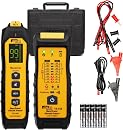 | Best for Serious Tracing Ideal SureTrace Plus 61-948Check Price | Check Price |
- For plain outlet work, I would rather carry a simple, tidy setup like the Klein Tools ET310 than pay for tracing features that stay in the case.
- If the house has oddball access points, buy around the connection kit first, because adapters decide whether the test starts at all.
- A display helps most when the panel is dim or crowded, so the KAIWEETS KT301P makes sense if tones alone drive you nuts.
- For dead wires, hidden runs, or panel work beyond receptacles, step up to a real tracer like the Ideal SureTrace Plus. Those runs usually end at a junction that needs re-terminating, which is a job for the picks in my wire stripping tool guide.
- I treat clip leads and live panel work as the line where ratings and build quality matter more than saving a few bucks.
1. Klein Tools ET310

Picture an older house with a panel full of mystery labels like “lights?” and “Bob’s room,” except Bob moved out in 1998. This is where I like the Klein ET310. Plug the transmitter into a grounded receptacle, walk to the panel with the receiver, and start sorting the mess one breaker at a time. It does not try to impress you with a display or extra menu steps. It beeps, lights up, and gets you to the right breaker with very little fuss. Worth knowing there is also a bundled version, the Klein Tools ET310KIT, which adds alligator clips, a light socket adapter, a 3-prong to 2-prong adapter, and a hard case — handy if you plan to trace light fixtures and bare wires, not just outlets.
For mapping a whole unlabeled panel in one afternoon, that simplicity matters. I would still move slowly down each side of the panel instead of waving the receiver around like a magic wand. Give each breaker a steady pass, mark the winner with painter’s tape, then flip it and confirm the outlet goes dead. On a crowded panel, the ET310 can sometimes make neighboring breakers feel suspicious, so I do not trust the first chirp blindly. A second slow scan usually clears things up.
The built in GFCI outlet tester gives it more value than a plain breaker finder. While I am labeling kitchen, bath, garage, or exterior outlets, I can also check the receptacle wiring and trip the GFCI where appropriate. That is handy because panel mapping tends to uncover other little electrical mysteries. Funny how one Saturday project becomes three, right?
Compared with the KAIWEETS KT301P, the Klein feels more old school. The KAIWEETS leans on an LCD with live readings and more on screen feedback, which can be appealing if you want voltage and signal information in front of you. The Klein takes the opposite path. No screen. Fewer distractions. For a homeowner trying to label breakers without getting buried in data, I think that is a strength. It is the kind of tool I understand seeing in a pro’s bag because it does its main job and does not make a ceremony out of it.
ust mind the limits. This is for standard North American grounded outlets on 90 to 120 volt AC circuits. The bare ET310 also does not come with a dedicated case, though the two pieces store together neatly enough — and if you want the case plus the adapters, that is exactly what the ET310KIT above is for. If you want real time numbers while tracing, the next style of finder will suit you better. If you want reliable, plain spoken breaker hunting, this Klein earns its spot.
Pros:
- Simple beep and light
- Good for unlabeled panels
- Built in GFCI testing
Cons:
- Needs slow panel sweeps
- Can confuse adjacent breakers
2. KAIWEETS KT301P

The screen is the reason I’d pick the KAIWEETS KT301P over a plain breaker finder. I like seeing voltage, signal strength, and outlet status in one place because it gives me a little more confidence before I put a hand near a box. The receiver still has to lead you to the correct breaker, but the signal reading gives you a feedback loop instead of making you guess from beeps alone.
Compared with the Klein ET310, this feels more information heavy. The Klein leans on lights and sound to do the talking, which is fine for quick breaker hunting. I prefer the KAIWEETS when I’m working in an older house with mystery circuits, mixed outlet types, and a panel directory that looks like it was written during a power outage. The transmitter can also check GFCI outlets and show wiring condition, so I can trace the breaker and catch basic outlet problems during the same trip.
The adapter kit matters for real weekend work. The 3 prong to 2 prong adapter, light socket adapter, and alligator clip adapter let me trace more than standard receptacles, which is handy in basements, garages, and ceiling light circuits. AstroAI offers a similar bundle for less, so the KAIWEETS makes the most sense if you value the LCD readout and diagnostic detail more than the cheapest path to a labeled panel.
My main caution is the hold function. It keeps the last reading, which is useful if you unplug and want to check what you just saw, but it can fool you if you forget to reset before the next test. My habit would be simple: reset, test, flip the breaker, reset again, then confirm the voltage reads zero before touching anything. If all you need is basic breaker labeling, the next pick trims away the extras and keeps the spending lighter.
Pros:
- LCD with voltage display
- Signal strength feedback
- Useful adapter kit
- GFCI and wiring checks
Cons:
- Manual reset can confuse
3. AstroAI Circuit Breaker Finder

Next to the Klein ET310, the AstroAI feels a little less settled on the first sweep. The Klein can still make me slow down and double check, but it tends to point me in the right direction sooner. This AstroAI wants a learning pass first, then a second scan to call the breaker, and I would not rush that process unless I enjoy relabeling half a panel twice.
For a budget minded homeowner mapping a single family panel, though, I think this kit punches above its lane. The receiver gives a tone and red blink at the panel, and the built in light is handy when the breaker box lives in the usual glamorous spot, beside a water heater under one tired bulb. My best results would come from holding the receiver the same way on every breaker, moving slowly, then repeating the scan before writing the label. If two neighboring breakers seem suspicious, reset your patience and run it again.
The adapter setup is the part I like most for one big labeling weekend. Receptacles are easy, but the included light socket option helps with ceiling lights that always seem to be on mystery circuits. The GFCI testing function adds value after the panel is labeled.
This is not the tool I would grab for dead wiring, de energized tracing, or 240V work. For normal 120V household breaker matching, it saves money and gets the job done. For deeper electrical troubleshooting, I would step into a different class of tester.
Pros:
- Budget friendly complete kit
- Adapters for lights and outlets
Cons:
- Needs two pass scanning
- Limited to live 120V
4. Ideal SureTrace Plus 61-948
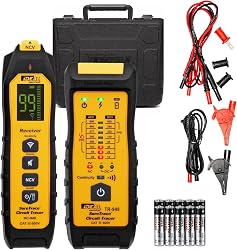
I warmed up to the Ideal SureTrace Plus 61 948 fast because it feels like a tool built for the messier side of electrical work, not just the tidy outlet to breaker routine. If I am labeling a bedroom receptacle circuit on a Saturday morning, this is more tool than I need. If I am alone at a panel, chasing a dead run, checking a 240V circuit, or trying to prove the right circuit is off from both ends, this starts making a lot more sense.
The big split between this and something like the Klein ET310 or KAIWEETS KT301P is simple. Those are useful for finding breakers from live receptacles and getting basic outlet information. The SureTrace Plus steps into jobs those tools are not built to handle. It can work on energized and de energized systems, covers up to 600V AC and DC, and is rated for CAT III work. That matters if the project has moved past “which breaker feeds this outlet” and into fault finding, panel cleanup, or tracing conductors where power may not be present.
The CertainCircuit feature is the part I would pay for if I worked solo often. I do not love running back and forth between a panel and the far end of a circuit, hoping I killed the right breaker and did not fool myself. This setup gives confirmation at the panel and at the circuit end, which saves steps and lowers blood pressure. The built in continuity test, voltage indication from low voltage ranges up to 600V, and non contact voltage detection also mean I am not constantly swapping between separate testers.
It is not magic. I would expect a learning period, especially if all I had used before was a plug in transmitter and wand style breaker finder. Sensitivity can need attention, and there are reports of the occasional bad unit right from the start. For critical commercial work, the higher 61 959 model still sounds like the more precise pick.
For advanced DIYers and solo electricians, though, this is the one consolidated tool here that reaches beyond breaker finding. Buy it for serious tracing. Skip it if all you need is to label a few outlets before lunch.
Pros:
- Traces dead circuits
- Works up to 600V
- Solo verification feature
- Built in continuity testing
Cons:
- Premium pricing
- Requires practice
How to Pick the Right Circuit Breaker Finder for Your Setup
Detection Accuracy and Consistency
A circuit breaker finder earns its keep on the first scan. If it points to three neighboring breakers, I do not call that “sensitive.” I call that a walk back across the house. False positives waste time, and worse, they make you stop trusting the tool.
Most plug in breaker finders use a transmitter at the outlet and a receiver at the panel. The receiver listens for the signal and beeps or lights up near the matching breaker. Tools like the Klein Tools ET310 are built for this basic job, and the better ones get more consistent after a calibration pass across the panel.
Scan every breaker once to let the receiver learn the panel, then make a second slower pass to confirm the strongest hit. Keep the receiver tip square to the breaker face, move at a steady pace, and do not wave it around like you are blessing the panel. If the tool has sensitivity adjustment, start broad, then narrow it down once you are near the suspected breaker.
Multi Function vs. Single Purpose
A plain breaker finder does one job: it tells you which breaker feeds a live receptacle. For many weekend jobs, that is enough. Replacing outlets, labeling a panel, tracking down the breaker for a bedroom circuit, simple stuff.
Combo tools add features such as GFCI testing, wiring fault indicators, non contact voltage detection, and sometimes a voltage readout. The Klein ET310 combines breaker finding with a GFCI outlet tester. The KAIWEETS KT301P goes further with a backlit display, outlet fault diagnostics, non contact voltage detection, and adapters. More features can save trips to the toolbox, but they also add buttons, modes, and more ways to misread the screen.
- Choose a basic finder if you mainly label 120 volt outlets.
- Choose a combo tool if you test GFCI outlets, check wiring faults, or work in several rooms during one project.
- Choose a tracing kit if you need to follow wires beyond a standard receptacle circuit.
Voltage Range and Circuit Compatibility
This spec eliminates a lot of tools fast. Many budget and middle tier breaker finders are made for energized 90 to 120 volt AC receptacle circuits. That matches most household outlets in the United States, so it works fine for lamps, TVs, bedrooms, kitchens, and garages.
It does not cover everything. Dryers, ranges, water heaters, well pumps, mini splits, and some shop equipment may use 240 volts. Doorbell wire, thermostat wire, landscape lighting, and dead circuits are a different problem again. A basic plug in finder usually will not trace those.
Before you buy, match the tool to the circuits you need to identify, not just the outlets you already understand. If you need energized and deenergized tracing, or you need to follow conductors through walls and junction boxes, look at a true circuit tracer such as the Ideal SureTrace Plus instead of a simple outlet style breaker finder.
Included Accessories and Adapters
The transmitter has to connect to the circuit somehow. A standard three slot outlet is easy. Older homes get more interesting. I still run into two slot receptacles, switched ceiling light boxes, garage outlets behind freezers, and mystery circuits with no convenient plug in point.
Adapters matter because they turn a “nope” into a five minute test. The AstroAI Circuit Breaker Finder and the KAIWEETS KT301P both lean into this by including adapter kits, which helps if your house has a mix of old and new wiring points.
- A two prong adapter helps with older receptacles.
- A light socket adapter helps identify switched lighting circuits.
- Alligator clips help when you have safe access to conductors or terminals.
- A case keeps the transmitter, receiver, and adapters together.
Buy the kit with the adapters you will use, because loose electrical adapters have a magical way of disappearing into the same drawer as dead batteries and hex keys.
Solo Operation and Workflow
Most DIY electrical work happens with one person, one panel, and a lot of walking. If the outlet is upstairs and the panel is in the basement, a vague tool turns the job into cardio. I like exercise. I do not like unnecessary stairs while holding a flashlight in my teeth.
Look for features that help you confirm the result without a helper. Auto hold displays, clear audio tones, strong visual indicators, and a transmitter that shows outlet status all make the process smoother. Some advanced tracers add verification at both ends, so you can confirm the circuit is the one you meant to shut off.
The Ideal SureTrace Plus is built more for that workflow than a basic finder, with circuit tracing features aimed at single person use. For simple outlet identification, a dockable design like the Klein ET310 also helps because the transmitter and receiver stay together between jobs.
Safety Ratings and CAT Certification
A breaker finder may look harmless, but it still gets used around live electrical equipment. The receiver might only scan the breaker face, while adapters and clips can put your hands near energized parts. That is where safety ratings matter.
CAT ratings describe the electrical environment a tool is designed to survive. CAT III is commonly associated with distribution level work, including panels and branch circuits inside a building. It is not just marketing. A properly rated tool is built and tested for voltage spikes that can happen on real wiring systems. The same rating logic applies to whatever else goes in that panel with you, and I broke the CAT categories down properly in my multimeter roundup.
If you plan to probe inside a live panel, use a tool with a clear CAT rating and keep your fingers behind the guards. Some bargain tools do not list formal certification, and that is a risk trade off. I am comfortable using inexpensive tools for simple plug in outlet identification, but live panel contact is where I stop being cheap.