

You reach for a bit, line it up on your mark, and pull the trigger. Instead of biting in, it spins and skates across the steel like a figure skater who missed practice. You lean harder. Smoke curls up. Still nothing. That dull bit just cost you a clean hole, and if your solution is to toss it and grab a new one every time, you’re feeding a slow money pit that never fills up.
Here’s the thing nobody tells you at the hardware store checkout: most bits have plenty of life left, they just need a fresh edge. A sharp bit does the work so you don’t have to. The best drill bit sharpener earns its spot on your bench by matching your actual habits, not some fantasy version of your shop where you drill titanium all day.
So the real question isn’t which machine has the most chrome. It’s how many bits you burn through, what you’re drilling into, and how much fussing with jigs and angles you can stomach on a Saturday. Get that right and the choice gets easy. Get it wrong and you’ve bought another dust collector. Let me walk you through it.
Best Drill Bit Sharpeners in 2026
| Image | Model | |
|---|---|---|
 | Best Overall Drill Doctor 750XEditor's Choice  Check Price | Check Price |
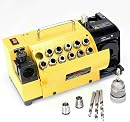 | Best for Precision Grinding MRCM MR-13ACheck Price | Check Price |
 | Best for Simple Sharpening Drill Doctor 350XCheck Price | Check Price |
 | Best for Bench Grinders General Tools 825Check Price | Check Price |
 | Best for Tormek Owners Tormek DBS-22Check Price | Check Price |
1. Drill Doctor 750X

If your shop looks anything like mine, you’ve got a coffee can full of dull bits nobody wants to touch. Twist bits, a few masonry ones, some cobalt that cost too much to toss. The Drill Doctor 750X is the machine I reach for when that can needs emptying, mostly because it swallows more variety than anything else in its price class.
The headline for me is range. It handles bits from 3/32″ clear up to 3/4″, and the point angle adjusts anywhere from 115 to 140 degrees. That flexibility matters when you’re bouncing between materials in a single afternoon. Masonry, carbide, cobalt, tin-coated, they all go through the same chuck.
Here’s where the step-up over the simpler 350X earns its keep. The 350X locks you into a fixed 118 degree grind with a two-step routine, which is fine if all you sharpen is standard twist bits. But the second you drop a bit ground to a different geometry, you’re fighting it. The 750X lets me dial the angle to match, and the split-tip feature puts a real bite back on bits that have gone dull in the center. For a mixed collection, that adjustability is the whole reason to pay more.
It’s not flawless. The angle slider is stiff and stubborn between the 118 and 135 settings, so I usually give it a firm nudge and double-check by eye. The split-point port takes practice to get consistent, and honestly I botched a couple before I got the feel for it. Bits above 1/2″ sometimes need two or three passes. And it throws metal dust that the access panels don’t fully catch, so I run it near the shop vac.
Damaged bits come back to life in under a minute, and the diamond wheels hold up under steady use. Backed by a 3-year warranty and Oregon engineering, it’s the closest thing to a do-everything sharpener I’ve found without stepping up to shop machinery.
The 750X wins on range, but if pure sharpening accuracy tops your list over versatility, there’s an all-metal machine that chases precision from a completely different direction.
- Widest bit range in class
- Adjustable 115–140° angles
- Revives broken bits fast
- Long-lasting diamond wheels
- Stiff angle slider
- Messy dust, tricky split-point
2. MRCM MR-13A
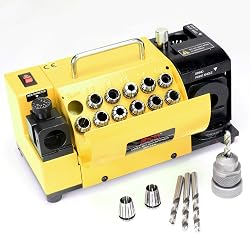
I’ll be honest, the first time I ran a beat-up HSS bit through the MR-13A, I stood there squinting at the edge like I’d done something wrong. It came off sharper than the day I bought the thing. That’s the CBN wheel earning its keep. Cubic boron nitride leaves a surface finish that rivals new stock, and on high-speed steel it grinds clean without cooking the temper.
The build is where this machine separates itself. Solid 45# steel, no plastic collars or chuck bits waiting to crack. Compare that to the Drill Doctor 750X, which does a lot right but wraps its diamond wheel in a plastic housing that feels flimsy after a few hundred grinds. The 750X gives you a basic split-point. The MR-13A gives you a repeatable edge inside 0.1mm, run after run.
Thirteen collets cover 3 to 15mm, and the point angle swings from 95° to 135°, so I can dial in geometry to match aluminum, mild steel, or whatever abrasive junk is chewing up my bits that week. Three steps, under 30 seconds a bit once you’ve got the rhythm.
Now the catch. The manual is thin. It skips real guidance on centering the bit, which drives your relief angle, and the web diameter dial ran slightly off on mine until I fine-tuned it by feel. First few bits will be trial and error. Push through that and it’s a machinist’s quiet weapon.
Not everyone needs edges this precise, though. If your goal is reviving a drawer of dull bits on a lazy Saturday without wrestling a learning curve, there’s a friendlier tool worth a look.
- Edges sharper than factory
- All-metal, no plastic wear
- Precise to 0.1mm
- Vague manual, learning curve
3. Drill Doctor 350X

If you’re the type who dulls a handful of twist bits over a weekend and dreads fiddly setup, the Drill Doctor 350X is built for your patience level. There’s no alignment port, no angle slider to wrestle with. You clamp the bit in the V-block jaws, turn the chuck to lock the preset 118° grind, and touch it to the diamond wheel. Two steps. That’s the whole dance.
The diamond wheel is the part I’d brag about. It holds its shape and keeps bits cool, so you’re not cooking the temper out of your steel while you work. Once you’ve got the rhythm, a standard bit takes well under a minute to bring back to life. Use a light touch and let the wheel do the cutting.
Now, the tradeoff. That fixed 118° angle is both the charm and the ceiling. The step-up 750X gives you adjustable angles from 115° to 140° and handles bits up to 3/4″, but you pay for it in a stiffer learning curve. If you mostly run common bits up to 1/2″, the 350X’s simplicity wins. Just go easy on the plastic chuck parts and skip the heavy metal-cutting bits.
But maybe you’ve already got a bench grinder humming in the corner and just want a cheap attachment to bolt on.
- True two-step process
- Cool-running diamond wheel
- Under a minute per bit
- Fixed 118° angle only
4. General Tools 825

If you already have a bench grinder bolted to your workbench, this little attachment from General Tools is the cheapest path to genuinely sharp bits I’ve found. Notice I said “if.” The 825 clamps onto your existing grinder with a vice clamp, which means no grinder, no dice. And if your grinder sits on a post stand, you’re out of luck entirely.
Setup is where this thing tests your patience. Getting the alignment dialed in took me a couple of frustrating evenings and a YouTube video or two, because the instructions leave a lot unsaid. I’ve also heard of boxes showing up short a bracket or the indexer, so check your parts before you start.
Here’s the payoff. Once it’s aligned, I get edges that rival sharpeners costing three times as much. The pivoting neck grinds both flutes evenly, and five point angles from 41 to 88 degrees cover most of what I throw at it, roughly 1/8″ up to 3/4″. Skip the tiny bits though.
Compared to the plug-and-play 350X, the 825 asks for real effort up front but rewards you with a better edge. If you’d rather trade sweat for savings, this is your tool. Next up, something that ditches dry grinding entirely: water-cooled, patient, and fussy about precision.
- Factory-sharp edges once aligned
- Five point angles, 41 to 88
- Beats pricier sharpeners on cost
- Fussy setup, thin instructions
- Needs a bench-mounted grinder
5. Tormek DBS-22

Let me be straight with you: the Tormek DBS-22 isn’t a drill bit sharpener you buy on a whim. It’s a jig attachment that bolts onto a Tormek water-cooled system you already own. If you don’t have a T-4, T-7, T-8 or one of the older Supergrinds sitting in your shop, this review is mostly window shopping. But if you do own one, keep reading, because nothing else on this list touches what it produces.
The headline is the 4-facet point grind. Every other sharpener here gives you a split-point at best, and all of them grind dry. The DBS-22 brings the tip to a true chisel edge across four facets, and that geometry matters. The bit self-centers instead of walking, drills rounder holes, and the water cooling means the steel never gets cooked. Tormek claims up to 4x the life of a new conventional bit and around 70% less heat while drilling. I believe it, because there’s no way to burn the temper out of an edge you’re grinding under water.
Here’s the honest trade-off. This thing is slow. Really slow. First-time setup can eat 30 minutes before you’ve touched steel, and aligning the bit in the holder by eye is fiddly even with the included magnifier. Nail the alignment or the whole facet geometry drifts. My tip: do all your alignment fussing before the wheel is spinning, and keep a spare bit handy to practice on so you’re not learning on your good cobalt.
A few gripes at this price. The sliding surfaces stay sticky even after the grease, and it ships in a plain cardboard box with no case. Small stuff, but it stings when you paid premium.
So that’s the lineup. Five sharpeners, five very different personalities. Match the tool to how you actually work, and your bits will thank you for years.
- True 4-facet self-centering edge
- Water-cooled, no burnt temper
- Slow, fiddly by-sight alignment
- Requires a Tormek base unit
How to Choose the Right Drill Bit Sharpener
Before I spend a dime on any sharpener, I lay out the bits I actually use and ask one honest question: which of these dull out fastest? That answer tells me more than any spec sheet. A sharpener is only worth owning if it fits the bits sitting in your box today and the ones you’ll buy next year. Here’s what separates a tool you’ll keep for a decade from one that ends up in a drawer.
Bit Size Range
Every sharpener has a floor and a ceiling on bit diameter, and that ceiling matters more than folks expect. Plenty of budget units top out at 1/2 inch. If you own spade bits, large twist bits, or anything reaching into 3/4 inch territory, that machine leaves your biggest, most expensive bits untouched. The Drill Doctor 750X handles up to 3/4 inch, which covers most of what a weekend woodworker or metalworker throws at it.
Pay attention to how the sharpener grips the bit, too. Collet systems clamp the shank precisely and tend to repeat their alignment better across dozens of bits. Chuck systems are quicker to load but can wander slightly on very small diameters.
Check the minimum size before you buy if you use tiny bits under 3/32 inch. Small bits slip out of jaws designed for beefier shanks, and a sharpener that stops at 1/8 inch is useless for fine electronics or model work.
Point Angle Adjustability
The angle ground onto the tip decides how the bit bites. A 118 degree point is the general-purpose standard and drills soft materials like wood and plastic cleanly. Step up to 135 degrees and you get a flatter point that self-starts on hardened metal without walking across the surface. Masonry and specialty work sometimes call for angles outside both.
Fixed-angle sharpeners keep life simple. You drop the bit in, grind, done. The trade is versatility: you’re locked into one geometry no matter what you’re drilling. Adjustable units like the 750X, which spans 115 to 140 degrees, let you match the grind to the job.
If you drill steel regularly, get a sharpener that reaches 135 degrees. A 118 degree bit tends to skate on hard stock, and re-grinding a wandered hole is a headache you can skip. That flat 135° point is also what a tap and die set depends on: a tapped hole is only as true as the pilot that started it.
Grinding Wheel Type
The wheel is where the sharpening happens, and the material it’s made from decides which bits you can safely touch. Three types dominate:
- Aluminum oxide: the common budget wheel. Fine for standard high-speed steel, but it loads up and runs hot.
- Diamond: cuts fast and stays flat, handles cobalt and carbide without complaint.
- CBN (cubic boron nitride): runs cool, holds its shape for years, and leaves a clean edge on HSS and cobalt.
Heat is the enemy. Grind a bit too hot and you draw the temper right out of the cutting edge, which means it goes dull twice as fast after you sharpen it. The MRCM MR-13A pairs a CBN wheel with an all-metal body, and users report split-point edges sharper than factory-new with less scorching.
One warning on coated bits: TiN and other coatings live only on the surface. Any sharpening removes the coating at the tip. That’s normal and the bit still cuts fine, so don’t expect the gold finish to survive a re-grind.
Ease of Setup and Learning Curve
Some sharpeners are genuinely two-step tools. The Drill Doctor 350X skips the alignment port entirely: clamp, grind, and you’re back to drilling in under a minute per bit. That’s the kind of simplicity that keeps a tool on the bench instead of in a box.
Jig-style rigs and multi-angle units sit at the other end. Something like the General Tools 825 delivers strong results once dialed in, but “dialed in” can mean half an hour of fiddling with your first bit while you learn where everything sits.
Be honest about your patience before you buy. If you sharpen a few bits a month and want zero fuss, a simple two-step unit will make you happier. If you enjoy the process and want precision, the fiddly setups reward the effort.
Build Quality and Longevity
Cost per sharpened bit is the number that matters over years, not the sticker. A plastic-housed sharpener runs cheaper up front, and the plastic itself rarely fails first. What wears is the alignment mechanism and the chuck jaws, and worn jaws mean bits sit crooked and grind unevenly.
All-metal builds like the MR-13A cost more but hold their tolerances through hundreds of bits. The clamping stays true, the wheel mount doesn’t flex, and the whole thing survives being knocked around a shop.
Look at how the grinding wheel is replaced. Wheels wear out no matter the housing, and a unit with cheap, available replacement wheels beats a sealed design that forces you to buy a whole new tool when the abrasive runs down.
Standalone vs. Attachment
This choice comes down to what’s already on your bench. Standalone electric sharpeners plug in and work on their own. Attachments need a host machine and turn it into a sharpening station.
- Standalone: the Drill Doctor 350X and 750X, the MRCM MR-13A. No extra equipment required.
- Attachment: the Tormek DBS-22, which mounts to a Tormek water-cooled system and grinds a 4-facet point with a true chisel edge that self-centers and runs cool.
The DBS-22 offers precision no standalone unit matches, but it only makes sense if you already own or plan to buy the Tormek system it bolts onto. Buying a whole water-cooled platform just to sharpen drill bits is overkill for most weekend users.
Confirm what you already own before choosing an attachment. A jig with no compatible grinder is money spent on a paperweight, while a standalone tool works the day it arrives.
Whatever you use, keep it off the angle grinder — freehand grinding wrecks the relief angle in seconds, and the angle grinders I tested earn their keep on cutting, not on bits.
Quick Picks: The Best Drill Bit Sharpener for Your Situation
You’ve seen the contenders. Now let me match them to real garages and real problems, so you can stop reading and start sharpening.
You own every bit under the sun
Twist bits, masonry, carbide, cobalt, big ones, tiny ones, all rattling around in the same drawer. You need one machine that doesn’t flinch at variety. Grab the Drill Doctor 750X. Its 3/32″ to 3/4″ span and swinging angle mean whatever you pull out of that drawer, it’s covered.
You’re a precision metalworker fighting hardened steel
You’re done watching bits skate across tough stock instead of biting in. What you want is repeatable, factory-beating accuracy. The MRCM MR-13A is your answer. Its CBN wheel and all-metal build grind edges that track dead true, down to 0.1mm consistency every time.
You’ve got Saturday projects and a drawer of dull bits
No patience for a learning curve. You want to fix a bit, drink your coffee, and get back to the project. The Drill Doctor 350X keeps it simple: clamp, lock the 118° preset, touch the wheel. You’ll be back to drilling in under a minute per bit.
There’s already a bench grinder gathering dust
You’ve got the grinder. It just sits there judging you. Put it to work with the General Tools 825, an attachment that turns idle iron into a real sharpening station for short money. Set aside an afternoon to dial in the setup, then you’re rolling.
Your Tormek does everything but drill bits
You’ve invested in the ecosystem, and drill bits are the last holdout. Close the gap with the Tormek DBS-22 jig. It plugs into your existing system, adds a water-cooled 4-facet grind, and can stretch bit life up to four times. One purchase and your shop is finally complete.